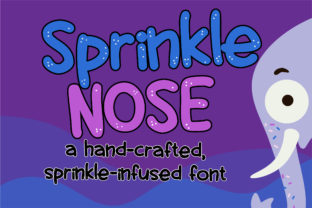
Sprinkle Nose
Imagine a font that doesn’t just sit quietly on the page—but dances, sparkles, and invites a smile. Sprinkle Nose is exactly that: a hand-crafted, whimsical display typeface where tiny sprinkles appear organically across letterforms—on curves, corners, and even inside counters. It’s not a novelty font you’ll use for body text or spreadsheets. But when you need to convey joy, playfulness, or handmade charm—whether for a bakery logo, a children’s book cover, a birthday invitation, or an Instagram story—it delivers personality with intention.
Why Sprinkle Nose resonates—and why it’s often misapplied
People love Sprinkle Nose because it feels authentic—not algorithmically generated, but drawn by hand, with warmth and irregularity. That’s its strength. But that same authenticity becomes a liability when used without context. Too many creators download it, type “Welcome!” in all caps, and drop it into a website header—only to realize later that readability collapses at smaller sizes, or that the sprinkles blur into visual noise next to dense paragraphs.
This isn’t a flaw in the font. It’s a mismatch between intent and application. Sprinkle Nose was designed for impact, not endurance. It thrives in short bursts: headlines, signage, packaging accents, social media graphics—places where attention is brief and emotion is immediate.
Common oversights—and how they quietly undermine your work
Assuming it works at any size. At 14px, the sprinkles in Sprinkle Nose don’t read as decoration—they read as distortion. Letters like “a”, “e”, and “o” can become ambiguous. One freelance designer used it for a café’s online menu headings, then discovered mobile users were squinting or skipping sections entirely. The fix? Switching to Sprinkle Nose only for the main banner (“Fresh Pastries Daily”), and pairing it with a clean, highly legible sans-serif (like Inter or Open Sans) for everything else.
Ignoring licensing scope. Sprinkle Nose is typically sold with clear usage boundaries—often covering desktop use, web embedding (with limits), and basic print. But if you’re building a SaaS dashboard where the font appears in user-facing UI elements—or embedding it into a mobile app—you’ll likely need an extended license. Skipping this step won’t break your site today, but it could trigger a compliance notice down the line, especially if your product scales. Always check the foundry’s license page *before* finalizing mockups—not after development begins.
Treating it like a full character set. Most versions of Sprinkle Nose include standard Latin characters, numerals, and basic punctuation—but rarely extended diacritics, currency symbols beyond $ and €, or multilingual support. A bilingual educator tried using it for a French-English preschool newsletter and hit gaps with accented characters like “é”, “ç”, and “ñ”. The result? Missing glyphs rendered as empty boxes. The better approach: confirm glyph coverage first (many vendors provide a PDF specimen or live character map), and plan fallbacks—like switching to a supporting font for non-Latin text blocks.
How to use Sprinkle Nose thoughtfully—not just festively
Start by asking: What emotion do I want the viewer to feel *first*—and what must they understand *immediately*? If the answer is “delight”, and the message is short (“Grand Opening!”, “Handmade with Love”, “You’re Invited”), Sprinkle Nose is likely a strong fit. If clarity, speed, or scanning matters more (“Ingredients”, “Store Hours”, “Terms & Conditions”), reach elsewhere.
Pairing matters deeply. Avoid stacking it with other decorative fonts—even ones that seem “friendly”. Two playful fonts compete; one joyful font + one neutral, functional one creates rhythm and hierarchy. Try Sprinkle Nose for your headline, then a well-spaced, modest-weight sans-serif (with generous letter-spacing and line-height) for subheads and body copy. Test the combination at actual viewing distances: hold your phone at arm’s length. Does the headline pop? Does the supporting text stay easy to parse?
Also consider color contrast. Those cheerful sprinkles lose definition against busy backgrounds—a textured paper scan, a photo overlay, or a gradient. On light backgrounds, deep charcoal or navy works better than pure black (which can feel harsh next to the font’s soft edges). On dark backgrounds, opt for creamy off-whites or warm beiges instead of stark white—reducing glare while keeping sprinkles visible.
Before you download or buy—three quick checks
- Preview it with *your* words. Don’t rely on the vendor’s demo phrase (“The Quick Brown Fox…”). Type your actual headline or brand name. Notice how letters like “g”, “y”, and “Q” behave—their descenders and flourishes interact uniquely with the sprinkles. Does “Berry Bliss Bakery” look cohesive—or does the “B” feel heavier than the “y”?
- Verify file formats included. Need web use? Confirm it comes with WOFF2 (for modern browsers) and optionally WOFF (for broader compatibility). Designing in Figma or Adobe apps? Ensure OTF or TTF is provided—and that it supports OpenType features like stylistic alternates, if those matter to your project.
- Read the EULA—not just the marketing. Some versions prohibit use in logos intended for resale (e.g., designing a logo for a client who’ll trademark it). Others restrict merchandise use unless you purchase an add-on license. When in doubt, email the foundry directly. Reputable creators respond quickly—and clarity now prevents revision headaches later.
Finally, remember: Sprinkle Nose isn’t about adding “more” to your design. It’s about inviting presence—of craft, care, and lightness. Used with restraint and awareness, it doesn’t distract. It delights *and* directs. It turns a simple word into a moment of recognition—“Ah, this feels handmade. This feels intentional.”
That’s the quiet power of a well-chosen display font. Not flashiness for its own sake—but resonance, earned through thoughtful selection and precise placement.