Berkat Yakin: Where Handwritten Warmth Meets Modern Clarity
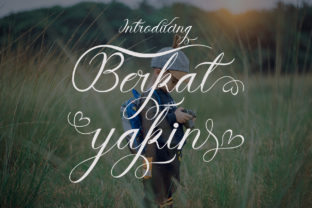
Imagine a font that feels like a personal note from a trusted friend—gentle, sincere, and unmistakably human. That’s Berkat Yakin. More than just another script typeface, Berkat Yakin bridges the emotional resonance of traditional calligraphy with the clean, uncluttered sensibility of contemporary design. It doesn’t shout; it invites. It doesn’t overwhelm; it comforts. And in today’s fast-scrolling digital landscape, that quiet confidence is rare—and deeply valuable.
A Font Born from Intention, Not Trend
Berkat Yakin isn’t built for novelty. Its origins lie in thoughtful reinterpretation: taking the graceful flow and delicate pressure variation of classic Southeast Asian and Arabic-influenced calligraphy—and distilling it into something accessible, legible, and versatile. The name itself hints at its spirit: “Berkat” (blessing) and “Yakin” (certainty)—a subtle nod to trust, sincerity, and grounded elegance.
Unlike ornate scripts that sacrifice readability for flourish, Berkat Yakin prioritizes clarity without coldness. Its letterforms feature soft entry and exit strokes, gentle curves, and balanced spacing—designed so that even at small sizes, words retain warmth and intention. There are no exaggerated swashes or forced ligatures. Instead, you’ll find consistent rhythm, subtle contrast between thick and thin strokes, and an organic sense of movement—like ink gliding across handmade paper.
Who Finds Meaning in Berkat Yakin?
This isn’t a one-size-fits-all font—but it *is* a perfect fit for people who value authenticity over artifice. Here’s who connects with Berkat Yakin most naturally:
- Creatives building personal brands—illustrators, poets, ceramicists, or wellness coaches who want their voice reflected in every visual touchpoint;
- Small business owners launching artisanal products, boutique services, or locally rooted experiences—where “handmade” isn’t a marketing buzzword but a lived reality;
- Designers crafting invitations, packaging, or editorial layouts seeking typographic harmony that supports storytelling rather than competing with it;
- Educators and nonprofit communicators aiming to convey empathy, care, and approachability in outreach materials or community guides;
- Content creators producing mindful digital spaces—think newsletters, landing pages, or social bios where tone matters as much as text.
Where Berkat Yakin Shines—and Where It Pauses
Berkat Yakin thrives in contexts where emotional resonance supports meaning. Consider these real-world applications:
- Wedding stationery: A handwritten-style font can elevate an invitation without veering into cliché. Berkat Yakin’s restrained elegance keeps focus on the couple’s story—not the typography.
- Product labels for small-batch goods: Think honey jars, herbal tea tins, or soy candles. Its delicate presence signals care in craft, not mass production.
- Book covers for literary fiction or memoirs: When a title needs to feel intimate and reflective—rather than bold or dramatic—Berkat Yakin offers quiet authority.
- Website headers and hero sections: Paired with a clean sans-serif body font (like Inter or Lato), Berkat Yakin adds humanity to digital interfaces without compromising speed or accessibility.
- Social media graphics for values-driven campaigns: Whether promoting mental health awareness or sustainable living, its sincerity helps messages land with grace—not guilt or urgency.
That said, Berkat Yakin knows its role—and respects boundaries. It’s not intended for:
- Long-form body text (e.g., blog posts or reports), where legibility over extended reading remains paramount;
- UI elements requiring high functional clarity (like form labels, error messages, or navigation menus);
- Brands built on high-energy, tech-forward, or aggressively minimalist identities—its strength lies in soft contrast, not stark minimalism.
Practical Expectations: What You Can (and Should) Anticipate
If you’re considering Berkat Yakin for your next project, keep these practical notes in mind:
- It works best at medium-to-large sizes—typically 24px and up for web, 14pt+ for print. At smaller scales, some fine details soften, which is intentional: it preserves its character without forcing legibility where it doesn’t belong.
- It includes OpenType features—standard ligatures, contextual alternates, and stylistic sets—that subtly enhance flow when enabled in compatible software (e.g., Adobe apps or modern CSS via
font-feature-settings). - It’s designed for Latin-based languages, with full support for Western European accents and punctuation. While it harmonizes beautifully with bilingual layouts (e.g., English + Bahasa Indonesia), it does not include extended Cyrillic, Arabic, or CJK glyphs.
- Web performance is thoughtful: The variable-weight version (if available) allows for efficient loading, and even static files remain compact—no bloated assets slowing down your site.
How to Know If Berkat Yakin Is Right for Your Project
Ask yourself three questions—not about aesthetics alone, but about intent:
- What feeling do I want someone to have before they read a single word? If “welcoming,” “thoughtful,” or “genuine” top the list—Berkat Yakin is likely aligned.
- Is this message meant to be absorbed slowly—or scanned quickly? If it’s the former (a love letter, a mission statement, a seasonal menu), Berkat Yakin deepens engagement. If it’s the latter (a safety notice, pricing table, or app onboarding), lean toward functional clarity instead.
- Does my brand voice sound like a person—or a platform? Berkat Yakin supports voices that speak with humility, warmth, and quiet conviction. It resists corporate-speak and algorithmic polish—and that’s its superpower.
You don’t need to “match” Berkat Yakin to a trend. You match it to a truth: that how something looks affects how it’s felt—and that sometimes, the most powerful design choice is restraint wrapped in sincerity.
Final Thought: Typography as Quiet Advocacy
In a world saturated with aggressive fonts, auto-tuned voices, and attention-hoarding visuals, choosing Berkat Yakin is a small act of resistance—and care. It says: I value the person reading this more than I value being seen first. It doesn’t chase virality. It cultivates resonance. And whether you're hand-lettering a thank-you card or selecting a font for your therapy practice’s website, that intention matters.
So go ahead—try Berkat Yakin in your next headline. Test it beside a warm neutral background. Read it aloud. Notice how it changes the weight of the words. Because great typography doesn’t just hold language—it honors it.