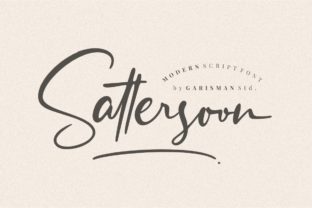
Sattersoon: Where Elegance Meets Modern Typography
Typography isn’t just about legibility—it’s about tone, intention, and emotional resonance. When you choose a font, you’re not selecting letters; you’re choosing a voice for your brand, your invitation, your packaging, or your campaign. And in a landscape saturated with minimalist sans-serifs and overused display fonts, Sattersoon stands apart—not by shouting, but by whispering luxury with quiet confidence.
A Script That Feels Intentional, Not Inherited
Sattersoon is a naturally modern script—meaning it avoids the stiff formality of traditional calligraphy while rejecting the chaotic looseness of trend-driven brush fonts. Its foundation lies in controlled, rhythmic strokes that flow like ink pulled gently across paper. But what truly sets Sattersoon apart are its end swashes: elegant, tapered flourishes that extend from terminals with subtle variation—not uniform repetition. These aren’t decorative afterthoughts. They’re expressive punctuation marks built into the letterforms themselves, lending movement, rhythm, and a sense of hand-crafted authenticity.
More than 170 ligatures deepen that expressiveness. Think beyond “fi” and “fl”. With Sattersoon, you’ll find contextual alternates like “Th”, “Qu”, “St”, and even multi-letter combinations that shift dynamically depending on surrounding characters. This isn’t automation for its own sake—it’s intelligent design that mimics how a skilled hand would adjust spacing and connection in real time. The result? Text that breathes, pauses, and connects—just like human writing should.
Why “Luxurious” Isn’t Just a Buzzword Here
Luxury in typography isn’t about gold foil or excessive ornamentation. It’s about considered detail, precision restraint, and unmistakable craft. Sattersoon delivers all three.
- Weight balance: Its medium contrast—neither starkly high-contrast like Didot nor flattened like many contemporary scripts—gives it presence without aggression. It holds up beautifully at large sizes (think signage or hero banners) and retains character even when scaled down to 18pt for elegant captions.
- Letterfit and spacing: Kerning pairs are thoughtfully tuned—not just for optical harmony, but for narrative pacing. Words like “celebration”, “forever”, or “artisan” gain subtle emphasis where it matters most.
- Character depth: With full Latin support, extended diacritics, and OpenType features enabled by default in professional apps (Illustrator, InDesign, Affinity), Sattersoon adapts gracefully across multilingual branding—ideal for global boutiques, luxury hotels, or international wedding stationery.
This isn’t a font that shouts “look at me.” It says, “You’re here for something meaningful—and I’ll honor that.”
Where Sattersoon Shines—And Where It Doesn’t Pretend To
Sattersoon thrives in contexts where tone carries as much weight as content. It’s ideal for:
- High-end hospitality: Hotel monograms on linen napkins, welcome signage in marble lobbies, or reservation confirmations that feel like handwritten notes from the concierge.
- Bridal and celebration design: Save-the-dates with delicate swash “y” endings, foil-stamped menu cards where “champagne” curls softly into “toasts”, or monogrammed ribbon tags for favor boxes.
- Luxury product packaging: Small-batch perfumes, artisanal chocolates, or ceramic tableware—where the font becomes part of the unboxing ritual, reinforcing craftsmanship before the product is even touched.
- Editorial features and limited-run books: Chapter headings in literary journals, quote callouts in slow-living magazines, or title treatments for coffee-table books on architecture or textile heritage.
It’s less suited for body copy, data dashboards, or UI buttons—no font should be everything. Sattersoon isn’t trying to replace Inter or Roboto. Its purpose is singular: to elevate moments that deserve reverence. Using it everywhere dilutes its power. But using it *exactly where it belongs*—that’s where magic happens.
Real-World Integration Tips
Getting the most out of Sattersoon means working *with* its intelligence—not against it.
- Enable OpenType features first. In Adobe apps, go to Window > Type > Glyphs, then click the “OpenType” icon. Turn on Contextual Alternates and Discretionary Ligatures. These aren’t optional extras—they’re core to Sattersoon’s rhythm.
- Pair intentionally—not oppositely. Avoid clashing extremes (e.g., ultra-thin geometric sans + Sattersoon). Instead, try warm, low-contrast serifs like GT America or soft grotesques like Harmony Sans. The goal is tonal cohesion, not visual friction.
- Test print early. Swashes and fine ligature lines can blur or break at low-res outputs. Always proof on the actual substrate—especially for letterpress, foil stamping, or textured paper.
- Respect hierarchy. Use Sattersoon for primary headlines or logotypes only. Subheads and body text benefit from supporting typefaces that share its warmth but offer clarity and scale.
Designers Are Choosing Sattersoon—Here’s Why
We spoke with three designers who recently integrated Sattersoon into client work—and their reasons reveal deeper truths about today’s typographic needs.
Alex, branding designer for boutique skincare lines: “Clients don’t want ‘pretty’. They want *trustworthy elegance*. Sattersoon feels human but never sloppy—like the founder personally signed every label. And those ligatures? They make ‘rosehip’ or ‘jasmine’ look like ingredients, not buzzwords.”
Mira, editorial art director: “We used Sattersoon for pull quotes in a feature on Japanese pottery. The swashes echoed the curve of a thrown vase rim—subtle, intentional, culturally resonant. Readers told us the typography made them *slow down*. That’s rare.”
Jamal, packaging lead for a small-batch whiskey brand: “Our label had to say ‘heritage’ without leaning on clichés—no oak barrels or eagle motifs. Sattersoon’s warmth and weight did that. Even the lowercase ‘w’ has this grounded, confident shape. It didn’t shout ‘premium’. It simply *was*.”
What to Consider Before Licensing Sattersoon
Licensing is straightforward—but thoughtful. Sattersoon is available through reputable foundries with clear desktop, web, and app usage terms. Before purchasing:
- Check your workflow compatibility. If you rely heavily on Figma or Canva, confirm OpenType feature support—or plan to use static alternates where needed.
- Assess volume needs. Web licenses scale with pageviews. A boutique site with 5k monthly visitors needs far less than an e-commerce platform pushing 500k.
- Think beyond pixels. If your project includes physical applications—embroidery, engraving, vinyl cutting—review the font’s vector integrity. Sattersoon’s clean curves translate well, but always request a test file from the vendor.
- Consider language scope. Standard licenses cover Western European languages. Need Turkish, Romanian, or Vietnamese support? Confirm extended character sets are included—or budget for custom extensions.
Ultimately, choosing Sattersoon isn’t about chasing trend. It’s about recognizing when a project calls for something quieter, more deliberate, and deeply human. It’s for designers who understand that the right script doesn’t just sit on the page—it settles into memory.
When your audience sees Sattersoon, they don’t just read your message. They feel its weight, its care, its intention. And in a world moving faster by the day, that kind of resonance isn’t just valuable. It’s essential.