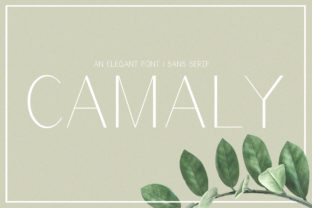
Camaly: The Modern Sans Serif That Elevates Purpose-Driven Design
When clarity, elegance, and quiet confidence matter most—whether you're launching a boutique brand, refining a SaaS dashboard, or crafting a thoughtful editorial layout—you need a typeface that supports your message without shouting over it. Camaly is exactly that: a thin, elegant sans serif font designed for today’s design sensibilities. It’s not just visually refined—it’s purpose-built to help professionals communicate with precision, warmth, and modern restraint.
Why Designers and Brands Are Turning to Camaly
Many professionals face the same quiet challenge: finding a typeface that feels current but never trendy, minimalist but never cold, distinctive but never distracting. Generic system fonts lack personality; overly decorative display fonts undermine readability and trust. Meanwhile, legacy “modern” sans serifs often feel dated—too rigid, too uniform, or too clinical for human-centered communication.
That’s where Camaly stands apart. Its subtle stroke modulation, generous x-height, and carefully balanced proportions deliver exceptional legibility—even at small sizes—while its slender weight and graceful curves introduce sophistication without pretension. It doesn’t compete with your content; it clarifies it.
How Camaly Solves Real-World Communication Needs
Unlike fonts optimized solely for headlines or UI elements, Camaly was developed with cross-context functionality in mind. Here’s how it helps solve everyday challenges:
- Building brand distinction on a budget: Startups and independent creators often lack resources for custom typography—but they still need to stand out. Camaly delivers a premium, cohesive voice across logos, websites, and social assets without licensing complexity or cost.
- Improving digital readability: In interfaces where users scan quickly—like dashboards, email newsletters, or product documentation—Camaly’s open letterforms and consistent rhythm reduce cognitive load and support faster comprehension.
- Elevating editorial tone: Whether you’re publishing long-form articles, annual reports, or thought leadership, Camaly’s quiet confidence conveys authority without stiffness. Its even texture makes dense text feel inviting—not intimidating.
- Supporting accessibility goals: While no font replaces proper contrast, semantic HTML, and responsive sizing, Camaly’s clear character shapes (like the unambiguous lowercase a, g, and l) contribute meaningfully to inclusive reading experiences.
Practical Applications—and What Works Best
Camaly shines when used intentionally—not as an afterthought, but as part of your communication strategy. Consider these real-world uses:
For Web & Digital Interfaces
Pair Camaly Light or Regular with a slightly more robust companion (like a neutral, highly legible sans for buttons and labels) to create visual hierarchy without contrast fatigue. Use it for body copy, pull quotes, and navigation labels—especially where whitespace and breathing room reinforce your brand’s calm, considered ethos.
For Brand Identity Systems
Because Camaly includes both upright and italic styles—and scales beautifully across weights—it functions well as a primary brand typeface. Its thinness allows for delicate monograms or elegant wordmarks, while its structural integrity ensures scalability from app icons to outdoor signage.
For Print & Editorial Design
In brochures, lookbooks, or whitepapers, Camaly performs exceptionally on coated and uncoated stocks. Its fine strokes hold up well in high-resolution print, and its even color (the overall gray value of a block of text) creates smooth, restful reading blocks—ideal for audiences consuming complex information.
Who Benefits Most—and How They Use Camaly Differently
Not every user approaches typography the same way—and that’s intentional. Here’s how different professionals integrate Camaly based on their priorities:
- UX designers use Camaly for interface text where clarity and emotional resonance matter equally—especially in wellness, finance, or education apps where trust is non-negotiable.
- Marketing teams adopt Camaly for campaign microsites and email templates because it balances brand polish with fast-loading performance (its clean vector outlines keep file sizes lean).
- Independent creators (writers, photographers, consultants) rely on Camaly to unify their portfolio, newsletter, and client-facing decks—creating continuity that feels personal, not templated.
- Print designers appreciate Camaly’s typographic rigor: consistent spacing, true italics (not skewed), and optical sizing options that adapt to context—so a caption looks right next to a headline, not like an afterthought.
Smart Implementation Tips
Getting the most from Camaly isn’t about using it everywhere—it’s about using it wisely. Here are grounded recommendations:
- Start with hierarchy: Use Camaly Light for captions and subheads, Camaly Regular for body text, and reserve Camaly Bold sparingly—for emphasis only where it truly adds meaning (not decoration).
- Respect line length: At its thinnest weights, Camaly benefits from generous line lengths (60–75 characters per line) and increased leading (1.5–1.6x font size) to maintain rhythm and legibility.
- Test across devices: Preview how Camaly renders on iOS, Android, and Windows. Its clean outlines generally render crisply, but always verify hinting behavior at 14–16px sizes in your target browsers.
- Pair thoughtfully: Camaly pairs well with structurally complementary fonts—not opposites. Try it alongside a warm, low-contrast sans (like Poppins or Manrope) for UI work, or a restrained serif (like Literata or IBM Plex Serif) for editorial depth.
A Typeface That Grows With Your Goals
Camaly isn’t a trend—it’s a tool for people who value intention over ornamentation. It meets you where you are: whether you’re refreshing a legacy website, building your first brand system, or refining a decade-old publication’s voice. Its strength lies in what it doesn’t do—distract, overwhelm, or date itself—and what it does consistently: support clarity, invite attention, and reflect care in execution.
If your goal is to communicate with quiet confidence—to make complex ideas feel accessible, elegant design feel effortless, and professional work feel authentically human—Camaly is more than a font choice. It’s a thoughtful alignment between how you think, how you speak, and how you want to be understood.