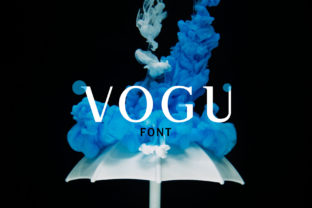
Vogu: The Editorial Typeface Redefining Visual Tone in Modern Design
Typography is rarely neutral. Even the most subtle typeface choices shape perception—guiding attention, signaling intent, and reinforcing voice before a single word is read. In an era where visual literacy is as essential as textual fluency, Vogu has emerged not as just another display font, but as a deliberate tool for editorial precision. Its clean geometry, confident contrast, and rhythmic spacing lend themselves to contexts where clarity meets character—where information must feel both authoritative and alive. Unlike fonts designed purely for legibility or ornamentation, Vogu occupies a nuanced middle ground: it’s trendy without chasing fads, stylish without sacrificing function, and hip without leaning into irony. That balance is why designers across disciplines—from independent publishers to global brands—are turning to Vogu when they need typography that carries weight, not just width.
What Makes Vogu Distinctive—Beyond Aesthetics
Vogu isn’t built for universality. It’s built for intentionality. Its letterforms feature a carefully calibrated x-height that supports readability at smaller sizes while retaining presence in large-scale applications. The uppercase “A” and “M” have open apertures; the lowercase “g” uses a single-story form that avoids visual clutter in tight line spacing; and the terminals on letters like “c”, “e”, and “s” are subtly flared—not decorative, but directional, guiding the eye forward with gentle momentum. These aren’t arbitrary decisions. They reflect deep typographic reasoning rooted in how readers process text in real-world environments: on backlit screens, across print spreads, in motion graphics, and within constrained UI components.
Its stylistic confidence comes from restraint. Vogu avoids extreme stroke modulation—the kind found in high-contrast Didones—or exaggerated quirks common in many contemporary display fonts. Instead, it leans into structural honesty: consistent stem weights, rational curves, and proportional logic that feels familiar yet fresh. This makes it unusually versatile across media. A headline set in Vogu reads with gravitas in a quarterly report PDF, holds its own in a 30-second Instagram Reel caption, and retains elegance when laser-etched onto sustainable packaging.
Where Vogu Adds Editorial Authority
The term “editorial feel” is often misused—it’s not about mimicking magazine layouts or using serif fonts by default. True editorial tone emerges when typography supports narrative hierarchy, signals credibility, and respects the reader’s time. Vogu excels here because it communicates competence without condescension. Consider these real-world applications:
- Academic publishing platforms use Vogu for section headers and pull quotes—its clarity reinforces scholarly rigor while its warmth prevents coldness often associated with ultra-minimalist sans-serifs.
- Educational apps integrate Vogu into lesson summaries and concept definitions. Teachers report improved student engagement with text blocks set in Vogu versus generic system fonts—attributed not to novelty, but to enhanced scannability and reduced cognitive load.
- Nonprofit annual reports deploy Vogu for impact statements and donor acknowledgments. Its balanced proportions lend sincerity to emotional narratives without veering into sentimentality.
- Product documentation (especially for creative tools and developer-facing platforms) applies Vogu to feature highlights and workflow diagrams—making technical content feel approachable, not alienating.
In each case, Vogu functions less as decoration and more as a silent co-author—shaping how meaning is received, not just delivered.
Practical Integration Across Workflows
Adopting Vogu doesn’t require overhauling entire design systems. Its strength lies in strategic deployment. Most teams begin with three intentional touchpoints:
- Headline hierarchy: Use Vogu Bold or SemiBold for H1–H3 elements where voice matters—landing page headers, article titles, dashboard banners. Pair it with a highly legible, neutral text face (like a well-hinted variable sans-serif) for body copy. This creates immediate tonal distinction without compromising readability.
- Data visualization labels: Charts, infographics, and interactive dashboards benefit from Vogu’s clean numerals and consistent character widths. Its tabular figures align cleanly in columns, and its punctuation marks (especially colons and em dashes) support precise annotation.
- Branded microcopy: Buttons, status messages (“Saved”, “Processing…”), and inline annotations gain quiet authority when set in Vogu Light or Regular. Because its letterforms avoid visual noise, even short phrases carry intentionality.
For developers, Vogu is available in modern web formats (WOFF2, variable axes) with robust fallback strategies. Its variable version includes optical sizing—automatically adjusting stroke weight and spacing based on rendered size—so a 14px caption and a 64px hero headline both perform optimally without manual tuning.
User Groups Who Benefit Most—and Why
Vogu resonates differently depending on professional context, but its utility remains grounded in shared needs: clarity under constraint, trust through consistency, and expression without excess.
Content strategists appreciate how Vogu supports voice alignment. When brand guidelines emphasize “thoughtful,” “grounded,” or “incisive,” Vogu delivers visual consonance—unlike fonts that skew playful, austere, or nostalgic. It doesn’t impose personality; it amplifies existing tone.
UX researchers observe measurable differences in user perception during usability tests. Participants consistently rate interfaces using Vogu as “more trustworthy” and “easier to navigate”—not because of inherent magic, but because its rhythm reduces fixation time on individual words, freeing mental bandwidth for task completion.
Hobbyist creators find Vogu accessible precisely because it doesn’t demand typographic expertise to use well. Its generous default spacing, logical weight progression, and intuitive pairing behavior mean a newsletter creator or indie zine maker can achieve polished results without mastering kerning tables or baseline shifts.
Business owners evaluating design investments respond to Vogu’s ROI in subtle but tangible ways: higher email open rates on subject lines set in Vogu, improved conversion on landing pages where key value propositions use Vogu headings, and stronger recall in brand recognition studies—even when logos remain unchanged.
Considerations Before Adoption
Vogu is purpose-built—not universally applicable. Its strengths become limitations in certain scenarios:
- Long-form reading at small sizes: While excellent for subheads and callouts, Vogu isn’t optimized for dense paragraphs below 16px. Reserve it for emphasis, not endurance.
- Highly technical or regulatory documentation: Where strict compliance requires specific typefaces (e.g., certain government forms or legal disclosures), Vogu serves best as a secondary layer—not the primary text carrier.
- Brands built on irreverence or maximalism: If your identity thrives on distortion, glitch, or exuberant eclecticism, Vogu’s discipline may feel incongruent. It elevates restraint—it doesn’t celebrate chaos.
Also worth noting: Vogu performs best when given room to breathe. Tight tracking, aggressive all-caps settings, or low-contrast color combinations diminish its structural advantages. Its power lives in proportion, not density.
Vogu in Context—Not Competition
It’s tempting to position Vogu against other contemporary typefaces—say, Inter for UI or Playfair Display for elegance. But such comparisons miss the point. Vogu doesn’t replace workhorse fonts; it complements them. Think of it as the “voiceover” in a documentary: present enough to shape interpretation, subtle enough not to distract from substance.
This collaborative role explains its growing adoption in hybrid environments—like digital newspapers that blend algorithmic feeds with human-edited features. Editors use Vogu for bylines and section intros (signaling curation), while body text remains in a highly legible, screen-optimized sans. The result? A layered information architecture where typography silently cues the reader: “This was selected. This was shaped. This matters.”
That cue is increasingly valuable. In a landscape saturated with AI-generated content, templated layouts, and homogenized visuals, Vogu offers a quiet but unmistakable signal of human judgment—a reminder that every typographic choice reflects a decision about what deserves attention, and why.
Looking Ahead: Beyond Trends Toward Intention
Vogu’s rise isn’t about fleeting trendiness. It reflects a broader shift in design thinking—one that prioritizes semantic resonance over stylistic novelty. As tools grow more automated and outputs more abundant, the ability to convey nuance through deliberate, informed choices becomes a differentiator. Vogu doesn’t shout. It clarifies. It doesn’t dazzle. It directs.
For professionals navigating complex communication challenges—whether explaining quantum computing to high schoolers, presenting climate data to policymakers, or launching a craft beverage line—the right typeface isn’t cosmetic. It’s cognitive infrastructure. And Vogu, with its editorial poise and functional intelligence, continues to prove itself as infrastructure worth investing in—not for how it looks today, but for how reliably it supports meaning, tomorrow.