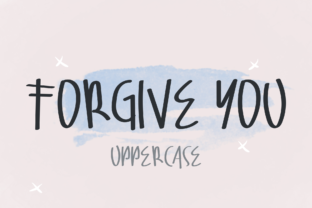
Forgive You: A Handwritten Font That Brings Warmth and Approachability to Your Designs
When you're crafting a message that needs to feel personal, sincere, and effortlessly kind—whether it's a heartfelt invitation, a wellness brand’s website, or a small business’s social media post—the right font can quietly do the heavy lifting. Forgive You is a soft, friendly handwritten typeface with a casual twist—designed not just to be read, but to be *felt*. It doesn’t shout; it leans in. Its gentle curves, relaxed spacing, and subtle irregularities mirror the warmth of human handwriting, making it an ideal choice for creators who want authenticity without sacrificing clarity.
Many designers and content creators face a quiet but persistent challenge: balancing professionalism with personality. Corporate fonts often feel distant or overly formal; some script fonts veer too far into ornate or decorative territory, sacrificing legibility or versatility. Others lack the emotional resonance needed for messages centered on care, healing, empathy, or self-compassion. If your work lives at the intersection of design and human connection—like mental health resources, mindful lifestyle brands, boutique wedding services, or inclusive educational materials—you likely need a typeface that supports your mission, not competes with it. That’s where Forgive You steps in—not as a stylistic flourish, but as a thoughtful tool for communication.
How Forgive You Supports Real-World Communication Goals
Forgive You excels in contexts where tone matters as much as text. Its easygoing rhythm invites readers to pause, breathe, and engage—not scan and scroll. Unlike rigid geometric sans-serifs or tightly kerned display fonts, Forgive You carries a sense of calm intentionality. This makes it especially effective for:
- Wellness and mental health initiatives—where language around self-forgiveness, boundaries, or gentle growth benefits from visual softness;
- Small creative businesses—such as handmade goods, plant shops, or independent bookstores—that prioritize authenticity over polish;
- Personal storytelling projects, like memoir zines, gratitude journals, or community-led workshops, where voice and vulnerability are central;
- Educational resources for adults seeking emotional literacy—where approachable design reduces cognitive load and builds psychological safety.
For example, imagine designing a printable “Self-Compassion Prompt Card” for a therapy practice. Using Forgive You for the affirmations (“You’re allowed to rest,” “This feeling won’t last forever”) reinforces the message through form—not just content. The font’s relaxed baseline and open letterforms subconsciously signal permission and ease, aligning typography with therapeutic intent.
Practical Applications—and What to Keep in Mind
While Forgive You shines in expressive, human-centered settings, its effectiveness depends on thoughtful implementation. Here’s how to use it well:
- Reserve it for emphasis and intimacy: Use Forgive You for headlines, short quotes, callouts, or signature elements—not long paragraphs. Its handwritten nature thrives in smaller doses, where its personality can land without overwhelming readability.
- Pair it intentionally: Contrast Forgive You with a clean, neutral sans-serif (like Inter, Lato, or Open Sans) for body text. This pairing creates visual hierarchy while maintaining warmth and professionalism—ideal for websites, email newsletters, or presentation decks.
- Optimize for digital legibility: At smaller sizes (under 18px), test rendering across devices. Forgive You performs best at 20–48px for headings and display text. On mobile, ensure sufficient line height and contrast—especially against light backgrounds—to preserve its gentle charm without sacrificing clarity.
- Consider licensing and usage rights: As with any premium font, verify whether your intended use (e.g., client work, SaaS platforms, embedded PDFs) is covered by the license. Many designers appreciate that Forgive You offers straightforward licensing options suitable for freelancers and small teams.
Different Users, Different Needs—Same Thoughtful Outcome
How you approach Forgive You will naturally vary based on your role and goals:
Freelance designers often use Forgive You to differentiate client brands in saturated markets—especially service-based or values-driven businesses. A nutrition coach’s Instagram carousel or a grief support nonprofit’s annual report gains emotional resonance when key phrases are set in Forgive You, subtly reinforcing trust and humanity.
Educators and workshop facilitators find it invaluable for handouts, reflection worksheets, or slide titles. Its familiarity—reminiscent of notes passed between friends or journal entries—lowers barriers to engagement, especially for adult learners navigating complex emotional topics.
Content creators building personal brands (think coaches, authors, or podcasters focused on mindfulness or relational health) lean into Forgive You for logo lockups, email headers, or book chapter titles. It signals alignment with their core values—kindness, patience, presence—without needing to state them outright.
Importantly, Forgive You isn’t about aesthetic trendiness. It’s about matching visual language to lived experience. In a digital landscape full of urgency and friction, choosing a font that feels like a deep breath is itself an act of intention—and sometimes, of quiet resistance.
Why This Font Fits Into a Larger Shift Toward Human-Centered Design
The growing preference for fonts like Forgive You reflects a broader movement: away from sterile uniformity and toward design that honors complexity, nuance, and emotional truth. Google’s Helpful Content guidelines emphasize expertise, experience, and empathy—and typography plays a supporting but vital role in delivering all three. When your audience is adults seeking meaningful solutions—not quick fixes—every design decision should reinforce credibility *and* compassion.
Forgive You supports that balance. It doesn’t pretend to have all the answers—but it creates space for questions to be asked gently. It doesn’t force confidence—but it affirms that showing up, imperfectly, is enough. And in practical terms, it helps your message land with more sincerity, more retention, and more heart.
If you’ve been searching for a way to make your communications feel less transactional and more relational, consider how Forgive You might serve your next project—not as decoration, but as dialogue. Whether you’re launching a new course, redesigning a resource page, or simply choosing a font for your weekly newsletter, let the softness of Forgive You remind you: clarity doesn’t require coldness, and kindness doesn’t need to be loud to be heard.