Gold Butter
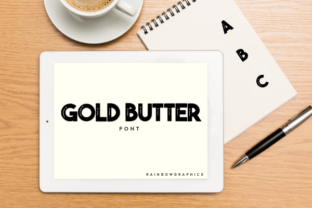
Gold Butter is an all-caps slab serif font designed with the bold clarity of mid-century advertising—think crisp letterforms, generous spacing, and a confident, grounded presence. It’s not just decorative; it’s functional typography built for visibility, personality, and immediate recognition. Unlike display fonts that sacrifice legibility for flair, Gold Butter balances visual impact with structural integrity, making it especially useful in contexts where hierarchy, tone, and intention must land quickly.
Where Gold Butter Fits in Your Design Workflow
Typography isn’t chosen in isolation—it’s selected as part of a broader decision chain: defining audience, clarifying message, choosing medium, aligning brand voice, and planning for scalability. Gold Butter enters this chain most effectively when you need to signal confidence, warmth, or nostalgic authenticity without slipping into kitsch. It works early in the process—as a mood-setter during concept development—or late, as a final polish on deliverables meant to stand out in crowded visual spaces.
For example, a small business owner designing a seasonal menu might sketch layout ideas using Gold Butter for section headers before settling on final copy. A freelance educator building a workshop handout might apply Gold Butter to learning objectives to visually distinguish them from supporting text. In both cases, the font isn’t just “added”—it’s leveraged to reinforce structure and intent.
Using Gold Butter Before a Project Begins
Pre-project use of Gold Butter often centers on alignment and framing. When teams collaborate on branding, packaging, or campaign assets, sharing a mockup with Gold Butter applied—even at low fidelity—helps stakeholders quickly assess tone and energy. Because it’s inherently declarative, it surfaces mismatched expectations early: if a client expects playful but reads “authoritative” instead, that conversation happens before hours are spent refining secondary elements.
Similarly, educators and course designers sometimes use Gold Butter in syllabus headers or module titles during curriculum mapping. Its strong visual weight makes it easy to scan across documents, helping identify gaps in pacing or emphasis before content is fully written. This isn’t about aesthetics first—it’s about using typographic contrast as a lightweight quality control tool.
During Execution: Integration Without Friction
Gold Butter integrates cleanly into common design environments—Figma, Adobe Creative Cloud, and even modern web builders like Webflow or Squarespace—provided you’ve installed the font file or linked the web version correctly. No special plugins or workarounds are needed. Its OpenType features are minimal by design (no stylistic alternates or ligatures), which means fewer compatibility surprises across platforms or export formats.
That simplicity supports consistency. If you’re managing multiple social media banners, email headers, or print materials for a local café, applying Gold Butter uniformly to all primary headlines creates instant cohesion—even when imagery, color, or layout vary. You’re not relying on perfect alignment or pixel-perfect spacing to communicate unity; the font itself carries part of that load.
One practical tip: pair Gold Butter with a neutral, highly legible sans-serif (like Inter, Lato, or even system fonts such as -apple-system or Segoe UI) for body copy. The contrast between its sturdy serifs and clean, open counters in the companion font reinforces hierarchy without competing for attention. Avoid pairing it with other high-contrast slab serifs or overly decorative scripts—those combinations tend to dilute clarity rather than enhance it.
Real-World Implementation Examples
- Small Business Signage: A boutique bakery uses Gold Butter for its storefront banner (“FRESH BAKED DAILY”) and matches it with a light gray sans-serif for operating hours below. The result feels intentional—not trendy—and holds up well at arm’s length.
- Educational Infographics: A science communicator uses Gold Butter for key takeaways (“WATER EXPANDS WHEN FROZEN”) while keeping explanatory text in a readable sans-serif. Viewers grasp the core idea instantly, then read details at their own pace.
- Event Promotion: A community center applies Gold Butter to headline text on digital flyers (“SUMMER CAMP REGISTRATION OPENS MAY 1”)—not for every line, but only where urgency and timing matter most. That selective use increases retention without overwhelming.
After the Project: Long-Term Usability and Maintenance
Fonts live beyond single projects—they become part of your asset library, brand guidelines, or team toolkit. Gold Butter’s straightforward licensing (available for both personal and commercial use, including web embedding) makes long-term adoption practical. There’s no need to re-license per project, track usage caps, or worry about attribution in most standard applications.
Still, usability over time depends on discipline. Save Gold Butter as a named style in your design system (e.g., “Heading – Primary Bold”) rather than applying it manually each time. Document where and why it’s used—“Gold Butter is reserved for hero text, event names, and product category labels”—so future collaborators understand its role, not just its appearance.
Also consider fallback behavior. When using Gold Butter on websites, always declare a robust font stack. For instance:
- Gold Butter (local or web)
- A generic slab serif (e.g., Georgia, "Times New Roman", serif)
- A safe sans-serif as last resort (e.g., sans-serif)
This ensures your messaging remains legible and structurally sound, even if the font fails to load.
Compatibility and Practical Constraints
Gold Butter is optimized for display use—not body text. Its all-caps nature and tight default letter-spacing mean it performs best at sizes above 24px in digital contexts and 18pt+ in print. Using it smaller risks reduced readability, especially for readers with visual impairments or those viewing on low-resolution screens.
It also doesn’t include lowercase, italics, or numerals with proportional spacing—so avoid relying on it for data tables, multi-line paragraphs, or mixed-case captions. That’s not a limitation; it’s a boundary that helps you make clearer decisions about where emphasis belongs and where neutrality serves better.
If your workflow includes automated tools—like Canva templates, Mailchimp campaigns, or Notion dashboards—check whether Gold Butter is available in those libraries before committing to it as a core element. If not, plan for manual upload or choose a close visual alternative (such as Bebas Neue or Anton) for interim use, then swap in Gold Butter for final exports.
Final Integration Tip: Let It Anchor, Not Dominate
The strongest use of Gold Butter isn’t when it’s everywhere—it’s when it marks moments of significance. Think of it like a signature stamp: applied once, with intention, where it confirms priority. Whether you’re launching a new service, announcing a workshop, labeling a physical product, or highlighting a learning outcome, let Gold Butter serve as that deliberate pause—the visual equivalent of saying, “This matters.”
That approach keeps your work focused, scalable, and human-centered. It avoids visual fatigue, supports accessibility through clear hierarchy, and gives your audience reliable cues about what to notice first. And because Gold Butter’s voice is consistent—not chameleonic—you build recognition gradually, across touchpoints, without needing to explain yourself every time.
In practice, that means opening your next design file, creating one text layer with Gold Butter, typing something essential—not clever, not cute, but true—and asking: does this help the viewer understand faster? If yes, you’ve used it well.