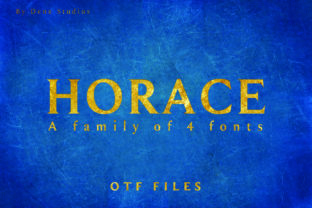
Horace: A Serif Font Built for Modern Workflow Precision
Horace is a serif typeface that balances structural strength with refined elegance—no compromise, no ornamentation for its own sake. It’s not nostalgic revivalism dressed up as modernity. Instead, Horace was designed with contemporary digital workflows in mind: high legibility on screens, consistent rhythm across weights, and subtle optical tuning that supports long-form reading, rapid scanning, and deliberate emphasis. For professionals who treat typography as infrastructure—not decoration—it’s a tool that integrates quietly but decisively into how work gets done.
Where Horace Fits in Your Real-World Process
Typography isn’t isolated. It lives inside documents, dashboards, presentations, emails, learning modules, product interfaces, and printed reports. Horace works where clarity and authority matter most: when you’re drafting a client proposal, structuring a course syllabus, refining a brand guideline, or designing a newsletter that needs to hold attention without shouting. Its even color, open counters, and generous x-height make it especially effective in mixed-media environments—say, a PDF report viewed on a tablet during a commute, then printed for an in-person meeting the next day.
Unlike fonts that demand attention through contrast or idiosyncrasy, Horace supports focus. It doesn’t distract from content—it clarifies hierarchy, signals tone, and reinforces credibility through consistency. That makes it particularly useful in phases where intentionality matters: planning (e.g., outlining a project brief), execution (e.g., writing documentation or building a slide deck), and review (e.g., proofing a whitepaper or editing a blog post).
Before the Work Begins: Preparation and Alignment
Choosing Horace early in a project helps anchor decisions—not just about type, but about voice, audience, and delivery context. If you’re launching a knowledge-based service, building a course platform, or developing internal training materials, selecting Horace signals a commitment to readability and professionalism before a single line of copy is written.
It pairs predictably with functional sans-serifs like Inter, IBM Plex Sans, or Roboto for UI elements, captions, or data labels—Horace handles body text and headings while its counterpart manages utility text. This division of labor reduces cognitive load for both designers and readers. When setting up a design system or content template, defining Horace as the primary serif (and specifying fallbacks like Georgia or Times New Roman for legacy environments) creates immediate consistency across tools: Figma files, Notion databases, Google Docs, and static site generators all behave more uniformly when the typographic foundation is intentional.
During Execution: Integration Across Platforms and Tools
Horace is available in variable and static formats, making implementation flexible. Use the variable version in CSS for responsive weight and width control—ideal for dynamic web content where users switch between devices or accessibility settings. In print or PDF workflows, static OTF/TTF files ensure pixel-perfect rendering in Adobe InDesign, Affinity Publisher, or even LaTeX via fontspec.
For educators building lesson plans in Canva or Google Slides, Horace’s regular and bold weights provide enough contrast to distinguish section headers from explanations—without needing multiple type families. Freelancers sending branded proposals via PDF can embed Horace reliably; clients viewing them on Windows, macOS, or mobile won’t see substitution glitches if embedding is enabled.
In collaborative writing tools like Notion or Obsidian, applying Horace via custom CSS (where supported) or exported HTML templates maintains visual continuity across notes, meeting agendas, and project retrospectives. The result? Less time spent adjusting formatting, more time spent thinking through implications, outcomes, and next steps.
Practical Implementation Tips
- Start with weight strategy: Use Horace Light for pull quotes or subtle captions, Regular for body text, Semibold for subheadings, and Bold for primary headlines. Avoid jumping straight to Bold for section titles—let Regular + increased size or spacing do the work first.
- Respect vertical rhythm: Set line height at 1.5–1.6 for body text at 16–18px. Horace’s even stroke modulation means tight leading can feel cramped; give it room to breathe, especially in dense documents.
- Test contrast rigorously: At smaller sizes or on lower-DPI screens, Horace Light may fall below WCAG AA contrast thresholds against light grays. Pair it with true black or near-black (#1a1a1a) for reliable readability.
- Leverage optical sizing if available: Some versions include text and display variants. Use the text-optimized cut for anything under 24px; switch to display for large-format posters or hero sections.
After Delivery: Consistency, Review, and Long-Term Use
A font’s value multiplies over time—not in novelty, but in reliability. Horace holds up across revisions, team handoffs, and platform migrations because its design prioritizes function over flourish. When updating a brand manual or refreshing a website, switching to Horace rarely requires reworking layout grids or rewriting content structure. Its metrics are predictable, its spacing logical, its character set comprehensive—including OpenType features like ligatures, small caps, and proportional figures that support precision without manual intervention.
For publishers managing archives or version-controlled content, Horace simplifies long-term maintenance. Its wide language support (Latin, Greek, Cyrillic, Vietnamese, and extended diacritics) means one family can serve multilingual blogs, academic papers, or global team handbooks—reducing font stack complexity and improving rendering speed.
How Horace Interacts With People and Decisions
Typography influences perception before comprehension begins. Horace communicates competence without coldness, approachability without informality. That matters in contexts where trust is earned incrementally: a freelancer’s first proposal to a prospective client, a teacher’s syllabus shared with skeptical students, or a startup’s investor deck reviewed by time-pressed VCs.
It also shapes internal dynamics. Teams using Horace in shared documentation often report fewer formatting disputes during editing cycles—because the typeface’s inherent hierarchy reduces ambiguity about what’s a heading versus a note versus a callout. That’s not about aesthetics alone; it’s about reducing friction in decision-making, feedback loops, and revision tracking.
When evaluating tools—whether a new CMS, a design collaboration platform, or a document automation service—ask how easily Horace integrates. Does the platform allow custom font uploads? Does its export engine preserve hinting and kerning? Does its mobile app render Horace at usable sizes? These aren’t edge-case concerns. They’re workflow dependencies that determine whether typography supports execution—or becomes another layer of overhead.
Building Around Horace, Not Just With It
Horace works best when treated as part of a broader system—not a standalone fix. Pair it with structured writing practices (like inverted pyramid for emails or bullet-first outlines for reports), accessible color palettes (tested with tools like Stark or axe), and consistent spacing scales (e.g., 4px, 8px, 16px increments). Its strength lies in how it amplifies those systems—not replaces them.
If you’re rebuilding a personal knowledge base, start by applying Horace to your most frequently referenced notes—those you revisit weekly. Observe how readability shifts. Then extend it to templates: meeting minutes, project kickoffs, feedback forms. Let usage grow organically from need, not theory.
For small business owners managing their own marketing assets, Horace offers quiet differentiation. In a landscape saturated with geometric sans-serifs and playful display fonts, choosing a serif with modern proportions and technical rigor signals intentionality—not trend-chasing. It tells customers you’ve considered how information travels, how it’s consumed, and how it’s remembered.
Horace doesn’t ask you to change your process. It asks you to notice where clarity already matters—and then gives you a dependable way to reinforce it.