Bella Family Font Evaluation
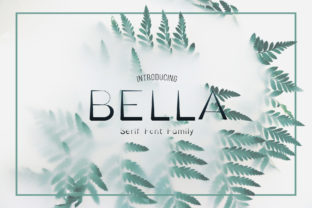
Bella Family is a serif typeface designed with strong visual character—featuring high contrast, pronounced serifs, and confident letterforms. It consists of multiple weights and widths, supporting both Latin and extended Latin character sets. As a display-oriented serif, Bella Family is intended for headings, logos, editorial features, and other prominent typographic applications where personality and presence matter.
Designers evaluating typefaces often prioritize how well a font supports their project’s tone, readability goals, and technical constraints. Bella Family stands out in contexts where elegance and boldness coexist—not as a neutral utility font, but as a deliberate stylistic choice. Its structure balances traditional serif proportions with contemporary flair, making it distinct from more conservative serifs like Garamond or more geometric ones like Playfair Display.
Why Designers Consider Bella Family
Several practical motivations drive interest in Bella Family:
- Distinctive voice: When a project requires immediate visual recognition—such as a magazine masthead, brand identity system, or exhibition title—Bella Family offers strong typographic personality without relying on decorative embellishment.
- Elegant contrast: Its high stroke contrast and sharp serifs lend sophistication to layouts, especially at larger sizes. This makes it effective for print-based editorial work or high-resolution digital banners.
- Consistent family structure: With coordinated weights (e.g., Light, Regular, Bold) and corresponding italics, Bella Family supports hierarchical typography without abrupt stylistic shifts between sizes or emphasis levels.
- Legibility in controlled settings: Though not optimized for long-form body text, its open counters and generous x-height support clarity in short-form applications like pull quotes, callouts, or navigation labels.
Benefits and Realistic Expectations
The primary benefit of Bella Family lies in its ability to elevate visual hierarchy and reinforce brand or editorial tone. Its design avoids the neutrality common in many modern serifs, offering an alternative when subtlety isn’t the goal. Users report that Bella Family performs well in branding projects where confidence and polish are central—particularly in fashion, culture, and premium lifestyle sectors.
However, expectations must align with its intended use. Bella Family is not built for extended reading. Its high contrast and tight spacing can reduce legibility in small sizes or low-resolution environments. On screens, especially at sub-24px sizes or on devices with limited pixel density, fine details may soften or disappear, affecting consistency across devices.
Also, while Bella Family includes standard Latin characters and common diacritics, its language support is narrower than open-source or enterprise-grade fonts. Projects requiring extensive multilingual coverage—including Central/Eastern European, Turkish, or Baltic languages—may encounter missing glyphs or inconsistent rendering.
When Bella Family Fits Well
Bella Family is a strong candidate in these scenarios:
- Editorial design: Magazine covers, section headers, or feature titles where typographic impact reinforces narrative weight.
- Branding systems: Logotypes or wordmarks needing timeless yet assertive presence—especially when paired with a simpler sans-serif for body copy or UI elements.
- Print collateral: Brochures, posters, or invitations where high-resolution output preserves fine detail and contrast.
- Limited-scope web use: Hero sections, testimonials, or navigation items displayed at ≥32px on desktop, with fallbacks defined for smaller viewports.
In each case, success depends less on the font alone and more on intentional pairing and implementation. For example, using Bella Family for a headline alongside a highly legible, low-contrast sans-serif (like Inter or Lato) creates balance: one supplies character, the other ensures clarity.
When to Consider Alternatives
Alternatives become more appropriate under certain conditions:
- Long-form digital text: If the project involves paragraphs, articles, or documentation, a more robust text serif—such as Merriweather, Source Serif Pro, or Adobe Caslon—offers better screen legibility and broader language support.
- Tight budget or licensing constraints: Bella Family is a commercial font. Projects with strict licensing requirements or no budget for type licensing may need freely licensed options with similar aesthetic goals—e.g., Crimson Text (for classic serif warmth) or Cormorant Garamond (for high-contrast elegance).
- Responsive interface needs: Applications requiring consistent rendering across mobile, tablet, and desktop—especially with dynamic sizing—benefit from variable fonts or families explicitly engineered for screen use, such as Recursive or IBM Plex Serif.
- Accessibility-first requirements: If WCAG compliance is a priority—particularly around contrast, spacing, and glyph distinction—fonts with tested accessibility profiles and OpenType features (like variable tracking or optical sizing) may offer more predictable outcomes.
Making a Practical Decision
Choosing Bella Family shouldn’t hinge on aesthetics alone. Start by auditing your project’s functional demands:
- Identify primary use cases: Will the font appear mostly in large-format print, static web headers, or responsive components? If usage spans multiple contexts, test Bella Family across those environments—not just in mockups, but in real builds.
- Review technical constraints: Check browser support for any OpenType features you plan to use (e.g., stylistic sets or ligatures). Confirm licensing permits your deployment method—web font hosting, embedded PDFs, or app bundling.
- Assess pairing compatibility: Try Bella Family with your intended body font at actual sizes and weights. Look for harmony in color (visual weight), proportion (x-height alignment), and tone (formal vs. relaxed).
- Validate with real content: Test with your actual copy—not lorem ipsum. See how it handles your longest headline, shortest call-to-action, and most complex punctuation.
Finally, consider iteration. A font choice isn’t irreversible. Many teams begin with Bella Family for concept work, then refine based on usability testing or performance metrics—swapping to a more versatile option if responsiveness or readability proves limiting.
In summary, Bella Family serves best when its strengths—bold presence, elegant contrast, and cohesive family structure—are matched to a project’s scale, medium, and intent. It is neither universally suitable nor narrowly niche; rather, it occupies a specific, valuable position in the typographic landscape—one that rewards thoughtful evaluation over instinctive selection.