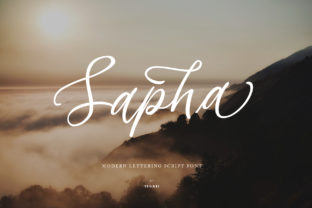
Sapha: A Light, Fun Handwritten Font with Strategic Charm
Typography isn’t just about aesthetics—it’s a quiet lever for clarity, connection, and intention. Sapha stands out not because it shouts, but because it leans in: a light, fun handwritten font with a cool, approachable charm. It doesn’t imitate calligraphy or mimic brush strokes—it breathes like human handwriting, with gentle irregularity, soft contrast, and subtle rhythm. That makes it unusually versatile for professionals who need authenticity without informality, warmth without whimsy.
Why Sapha Fits Real Work—Not Just Decorative Moments
Many designers reach for handwritten fonts when they want “personality.” But personality without purpose dilutes impact. Sapha works strategically because its lightness avoids visual weight that competes with content—and its consistency (within its intentional looseness) supports readability at moderate sizes. Unlike overly textured or exaggerated script fonts, Sapha retains legibility in short labels, email subject lines, slide headers, or app UI elements where tone matters as much as function.
Entrepreneurs building early-stage brands often over-index on “professional” fonts—sans-serifs so neutral they vanish. Meanwhile, educators crafting learning materials or freelancers designing client onboarding sequences need something that signals care without sacrificing credibility. Sapha bridges that gap: it feels handmade, but not childish; relaxed, but not careless.
Where Sapha Adds Value—And Where It Doesn’t
Use Sapha when your goal is to soften hierarchy, invite attention, or signal approachability—without undermining authority. Consider these grounded use cases:
- Brand voice reinforcement: A small business selling handmade ceramics uses Sapha for product tags and packaging notes—not for its full website body text, but for the “why we make this” section. The font quietly echoes craft, care, and continuity.
- Internal communication: A remote team uses Sapha in shared Notion dashboards for weekly reflection prompts (“What surprised you this week?”) or gratitude boards. Its lightness reduces cognitive load compared to bold sans-serifs—making participation feel lower-stakes.
- Educational scaffolding: An online course creator applies Sapha to key conceptual summaries (“Remember: Feedback isn’t judgment—it’s data”) embedded in longer lessons. It visually cues the reader: “Pause here. This is distilled.”
- Customer experience micro-moments: A subscription box brand uses Sapha for handwritten-style thank-you notes inside shipments—and mirrors that tone in follow-up emails (“Your box shipped today! 🌟”). Consistency builds recognition without repetition.
Conversely, avoid Sapha for legal disclaimers, technical documentation, data tables, or any context demanding immediate precision. Its charm lies in suggestion—not specification. If your goal is speed of comprehension or strict neutrality, default to a tested, highly legible system font instead.
Planning Your Use of Sapha: Three Practical Filters
Before applying Sapha, ask yourself these questions—not once, but each time you consider it:
- What outcome do I want this text to support? If the answer is “clarity,” “speed,” or “compliance,” Sapha is likely not the right tool. If it’s “connection,” “memorability,” or “human resonance,” proceed—but intentionally.
- Is this text meant to be scanned—or savored? Sapha thrives in moments readers slow down: a headline before a story, a caption beneath a photo, a signature line in an email. It weakens when forced into dense paragraphs or long-form instructions.
- Does it align with what users already know about me—or what I want them to know next? A law firm using Sapha for its blog’s “Meet the Team” bios reinforces approachability. Using it for court filing instructions would undermine trust. Match tone to expectation—and nudge, don’t jump.
This isn’t about rules. It’s about calibration. Sapha gains strength from contrast: pairing it with a clean, structured sans-serif (like Inter, Lato, or even system fonts) creates visual breathing room and clarifies roles—Sapha for voice, the other for structure.
Risks of Using Sapha Without Strategy
Unintentional use of Sapha introduces subtle friction. When applied randomly—say, mixing it across social posts, invoices, and login screens—readers subconsciously register inconsistency. That erodes perceived professionalism, even if no one can name why. Worse, overuse flattens its impact: if everything feels handwritten, nothing feels special.
Another risk is misalignment with audience context. A financial advisor targeting retirees might find Sapha too informal for retirement planning guides—even if it works beautifully in a quarterly “What’s New” newsletter. Age, literacy level, device usage (e.g., older adults on tablets), and cultural associations all shape how handwriting is received. Test—not assume.
Finally, accessibility matters. While Sapha passes basic WCAG contrast checks at larger sizes, its light weight and variable stroke thickness reduce legibility for some low-vision users at smaller sizes. Always pair it with sufficient line height, generous spacing, and fallbacks in CSS. Never rely on Sapha alone to carry critical information.
How to Build Long-Term Value with Sapha
Think of Sapha not as decoration, but as a recurring motif—a visual “yes” that signals alignment between message and medium. To build lasting value:
- Define its role clearly in your design system. Document exactly where and why Sapha appears—e.g., “Sapha is used only for handwritten-style quotes in case studies, and for first names in email signatures. Never for body copy or navigation.” Clarity prevents drift.
- Anchor it to behavior, not just appearance. Instead of saying “use Sapha for friendliness,” say “use Sapha when inviting reflection, acknowledging effort, or personalizing a response.” That ties the font to action and outcome.
- Measure its effect—not just impressions, but engagement shifts. Does a landing page with Sapha in its testimonial header increase scroll depth by 12%? Does an internal comms doc using Sapha for action items see higher completion rates? Track what matters to your goals—not just whether people “like” it.
Long-term, Sapha’s value compounds when it becomes part of a coherent pattern—not a stylistic flourish, but a functional choice. One freelance designer reports that clients now recognize her Sapha usage as shorthand for “this is the human-centered part”—freeing her to spend less time explaining intent and more time refining substance.
A Final Thought on Intentionality
Great typography doesn’t draw attention to itself. It draws attention to the idea. Sapha succeeds when it feels inevitable—not because it’s trendy, but because it fits the moment like a well-worn pen: familiar, reliable, and quietly expressive. That requires restraint. It means choosing Sapha not because it’s charming, but because charm serves the goal.
So before you set a single character in Sapha, pause. Ask: What do I want this person to feel? To understand? To do? Let that answer—not the font’s aesthetic—guide your decision. That’s how lightness becomes leverage, and fun becomes functional.