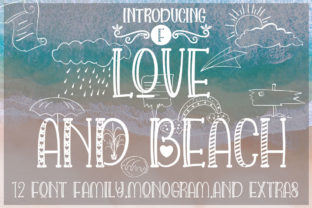
Love and Beach: A Handwritten Font for Romantic, Authentic Design
Love and Beach is a handwritten font that stands out not for technical precision or stylistic extremes—but for its quiet confidence in warmth and sincerity. It’s crafted with subtle variation in stroke weight, gentle irregularities in letterforms, and a natural rhythm that mimics the flow of ink on paper. Unlike many script fonts that lean heavily into flourishes or dramatic contrast, Love and Beach balances elegance with approachability. Its lowercase letters have soft entry and exit strokes; capitals carry presence without dominance. The result feels personal—not staged—making it especially effective when authenticity matters more than polish.
What Makes Love and Beach Distinctive
At its core, Love and Beach belongs to the “friendly script” category—but it avoids common pitfalls in that space. Many handwritten fonts either overemphasize decorative elements (making them hard to read at smaller sizes) or underdevelop character personality (resulting in generic, lifeless output). Love and Beach occupies a thoughtful middle ground: legible enough for short headlines and quotes, expressive enough to carry emotional weight. Its spacing is open but intentional—letters breathe without drifting apart. Kerning pairs are tuned for real-world use, so “love,” “beach,” and similar two- or three-letter words retain cohesion without manual adjustment.
The font includes standard Latin characters, numerals, and basic punctuation. It does not include extended language support (e.g., Cyrillic, Greek, or extensive diacritics), nor does it offer stylistic alternates, swashes, or contextual ligatures. That’s not a limitation—it’s a design choice aligned with its purpose: clarity and charm in focused applications, not versatility across global or typographic complexity.
Fitting Into the Broader Landscape of Handwritten Fonts
Handwritten typefaces fall along a spectrum—from tightly controlled calligraphic scripts to loose, sketch-like lettering. Love and Beach sits comfortably in the mid-range: more structured than chalkboard or brush scripts, yet less formal than copperplate-inspired designs. Compared to fonts with high contrast (like those modeled after pointed-pen calligraphy), Love and Beach uses modest contrast—thick strokes are warm and full, thin strokes remain visible but never fragile. This makes it more resilient across screen sizes and print resolutions.
It also differs from “bouncy” or exaggerated casual scripts—fonts where baseline undulation or inconsistent x-heights can distract from message clarity. Love and Beach maintains a stable baseline and consistent rhythm, supporting readability without sacrificing individuality. That stability becomes especially valuable in branding contexts where tone must remain cohesive across multiple touchpoints: a wedding invitation, a boutique packaging label, and a social media graphic all benefit from the same underlying voice.
Where Love and Beach Excels—and Where It Doesn’t
Love and Beach works best in situations where emotional resonance matters more than functional neutrality. Think: artisanal product labels, intimate event stationery, small-batch packaging, editorial features about relationships or travel, or personal websites with a strong narrative focus. Its strength lies in reinforcing an idea—not defining it. When paired with clean sans-serif body text (e.g., Inter, Lato, or even system fonts), Love and Beach adds texture without competing for attention.
It’s less suited for long-form reading, UI interfaces, data-heavy layouts, or environments requiring multilingual support. You wouldn’t use Love and Beach for a legal disclaimer, a technical manual, or navigation menus. Its charm is situational—not universal. That’s not a weakness; it reflects intentionality in scope. Fonts designed for broad utility often dilute their character. Love and Beach chooses focus instead.
Practical Use Cases and Realistic Pairings
In practice, designers often reach for Love and Beach when they need to signal care, intimacy, or craftsmanship. A small ceramics studio might use it for product tags (“hand-thrown in Portland”) alongside a neutral sans-serif for origin details. A travel blog highlighting coastal towns could feature Love and Beach in hero headers (“Salt Air & Slow Mornings”), then switch to a highly readable serif (like Merriweather or PT Serif) for article text. Even digital tools benefit: Canva templates using Love and Beach tend to perform well for wedding-related content—not because the font is “trendy,” but because it aligns with audience expectations around warmth and sincerity.
Color usage matters, too. Love and Beach reads cleanly against light backgrounds in muted tones (soft sage, warm beige, pale sky blue) or deeper, earthy hues (terracotta, charcoal, navy). It can feel washed out against pure white with ultra-thin weights or overly saturated backdrops unless carefully balanced. Testing at actual size—especially on mobile—is essential, since its subtlety can recede if contrast or spacing isn’t calibrated.
Comparing Fit: When to Choose Love and Beach Over Alternatives
Choosing Love and Beach isn’t about finding the “best” handwritten font—it’s about matching intent with execution. If your goal is to evoke spontaneity or creative energy, a looser, sketch-style font may communicate more directly. If you need flexibility across languages or variable font axes (weight, width, slant), Love and Beach won’t meet those needs—and that’s okay. Its value emerges when you prioritize consistency of feeling over range of function.
Consider alternatives only when your project demands something Love and Beach doesn’t provide: extended character sets, tighter tracking for compact spaces, or higher contrast for dramatic impact. For example, a luxury skincare brand targeting international markets may need broader language coverage and refined OpenType features—making Love and Beach a starting point for mood boards, but not the final typographic solution. Similarly, a festival poster needing bold visual impact at 20 feet might benefit more from a condensed, high-contrast script than Love and Beach’s gentle cadence.
Decision Factors to Keep in Mind
Before selecting Love and Beach—or any handwritten font—ask these questions:
- What emotion or association should the typography reinforce? Love and Beach supports warmth, sincerity, and handmade quality—not authority, speed, or futurism.
- How much text will appear in this font? It shines in short bursts: headlines, quotes, logos, monograms. Avoid paragraphs or dense captions.
- Where will it be used? Test across devices and outputs. Love and Beach holds up well in print and high-DPI screens, but may soften on lower-resolution displays unless scaled thoughtfully.
- Does the rest of the typographic system support it? Pairing matters. Love and Beach gains strength when anchored by a clear, unembellished companion font.
- Is authenticity the goal—or just aesthetics? Love and Beach resonates most when the overall design reflects genuine voice and intention, not just surface-level prettiness.
These aren’t barriers—they’re filters. They help clarify whether Love and Beach is serving the work, or the work is bending to accommodate the font.
Final Thoughts on Intentional Typography
Typography is rarely about one font solving every problem. Love and Beach doesn’t claim to. What it offers is reliability within its domain: a steady, heartfelt voice for moments that benefit from human imperfection and quiet confidence. It’s a tool for designers who understand that romance in design isn’t about hearts and roses—it’s about attention to detail, respect for context, and alignment between form and feeling.
If your project centers on connection—between people, places, or ideas—and you want typography that feels like a thoughtful note rather than a broadcast announcement, Love and Beach is worth exploring seriously. But always test it against your actual content, your real users, and your true goals—not just against other fonts on a specimen page. The right choice emerges not from comparison alone, but from how well a font supports what you’re trying to say, and to whom.