Mixed-Up Maggie: A Playful Font That Breaks the Rules—On Purpose
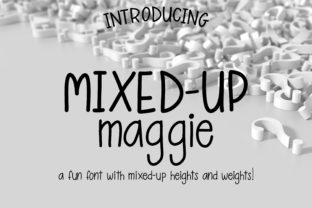
Imagine a font that doesn’t line up neatly, doesn’t follow the grid, and refuses to behave like every other typeface on your design panel. That’s Mixed-Up Maggie: a deliberately uneven, joyfully inconsistent display font where letter heights shift, weights dance between bold and light, and rhythm feels more like improvisation than orchestration. It’s not a bug—it’s the whole point.
What Makes Mixed-Up Maggie Stand Out?
At first glance, Mixed-Up Maggie looks like handwriting that’s been gently nudged by curiosity. Uppercase letters vary in height—not just slightly, but meaningfully. Some sit tall and proud; others shrink back or stretch sideways. Lowercase “a”, “e”, and “o” might appear rounded and full, while “t” or “l” lean in with unexpected thinness or thickness. Even punctuation marks carry their own personality—commas tilt, periods wink, and ampersands curl like ribbon.
This isn’t randomness for its own sake. Every variation is hand-crafted and intentional, designed to evoke spontaneity, warmth, and human imperfection. Unlike generative fonts that randomize on-the-fly, Mixed-Up Maggie offers curated inconsistency—predictable unpredictability you can trust across projects.
Key Characteristics You’ll Notice Right Away
- Height Variation: No baseline uniformity—letters rise and settle at different levels, creating natural visual texture.
- Weight Play: Strokes thicken and thin within single words, adding emphasis without bold tags or extra styles.
- Organic Spacing: Letter spacing shifts subtly—not kerning corrections, but expressive breathing room between characters.
- No Italics or Bold Variants: Its energy comes from internal contrast, not stylistic families—so it’s best used as a focused accent, not body text.
Who Benefits Most From Mixed-Up Maggie?
Mixed-Up Maggie isn’t for every project—and that’s part of its strength. It shines brightest when clarity takes a back seat to character. Think of it less like a utility tool and more like a signature stamp: distinct, memorable, and emotionally resonant.
Creatives and illustrators use Mixed-Up Maggie to reinforce handmade aesthetics—on greeting cards, zines, or limited-edition posters where polish feels sterile. Small business owners (especially in food, craft, or wellness) find it perfect for shop signage, packaging labels, or social media banners that need to feel personal, not corporate. And educators and workshop facilitators love it for handouts and presentation headers—it signals approachability and invites engagement, especially with younger audiences or playful learning themes.
Real-World Uses That Work Well
- Festival branding: A music or art festival logo using Mixed-Up Maggie instantly communicates creativity, inclusivity, and nonconformity—without saying a word.
- Children’s book covers: Its bouncy, friendly irregularity mirrors how kids see the world—full of surprises and gentle chaos.
- Instagram story text overlays: Short phrases (“You’re invited!”, “New batch just dropped”) pop with charm and authenticity against photo backgrounds.
- Podcast episode titles: When paired with clean sans-serif body text, Mixed-Up Maggie gives each episode its own voice—like a guest walking in with a distinctive laugh.
Where Mixed-Up Maggie Fits—and Where It Doesn’t
Like any expressive tool, Mixed-Up Maggie has boundaries—and knowing them helps you use it wisely.
It excels in short-form, high-impact contexts: headlines, logos, buttons, social graphics, chalkboard-style menus, and product tags. Its personality thrives where attention is brief and emotion matters most.
It’s not ideal for long reading: paragraphs, legal disclaimers, technical documentation, or accessibility-critical interfaces. The shifting baselines and variable weights can fatigue the eye over time—and may reduce legibility for some readers, including those with dyslexia or low vision. Always pair it with highly legible supporting fonts (like Inter, Open Sans, or Lato) for balance.
Also worth noting: Mixed-Up Maggie is currently available as a single-weight display font. There’s no condensed, italic, or monospace version—so if your project demands typographic flexibility across formats, plan accordingly. Consider it your “special occasion” font—not your everyday workhorse.
How to Evaluate If Mixed-Up Maggie Is Right for Your Project
Ask yourself three simple questions before downloading or licensing Mixed-Up Maggie:
- Is this meant to be seen—or read? If the goal is quick recognition (a logo, a t-shirt graphic, an event banner), yes. If users need to scan or digest information quickly, reconsider.
- Does my brand voice lean into playfulness, warmth, or handmade charm? If your tone is sleek, minimalist, or ultra-professional (think law firms or enterprise SaaS), Mixed-Up Maggie may clash rather than complement.
- Do I have control over context and size? It performs best at larger sizes (24px and up on screen, 18pt+ in print). At small sizes or low-res displays, details blur and the effect weakens—or worse, becomes distracting.
A Quick Pairing Tip
When combining Mixed-Up Maggie with another font, choose one with strong structure and neutral personality. A geometric sans-serif works beautifully—not because it matches, but because it grounds the exuberance. Try setting Mixed-Up Maggie for your headline and a clean, open-font like Inter or Manrope for body copy. The contrast tells a richer story than either font could alone.
Beyond Aesthetics: What Mixed-Up Maggie Says About Design Today
In an era of algorithm-driven layouts and AI-generated visuals, Mixed-Up Maggie feels quietly rebellious. It reminds us that design isn’t only about efficiency or scalability—it’s also about resonance. A font that breaks rules thoughtfully invites pause. It asks viewers to slow down, smile, and connect—not just process.
That’s why educators use it in classroom posters—to spark conversation before the lesson begins. Why indie bakeries use it on cupcake wrappers—to suggest care, whimsy, and something made by hand. Why podcast hosts use it in intro animations—to signal, “This won’t sound like everything else.”
Mixed-Up Maggie doesn’t try to solve a problem. Instead, it answers a quieter question: How do we make digital space feel more human?
Final Thought: Use It With Intention, Not Just Novelty
Fonts like Mixed-Up Maggie are easy to love at first sight—but lasting impact comes from thoughtful application. Don’t reach for it because it’s fun. Reach for it because it deepens your message. Because it reflects who you are—or who you want your audience to feel they are in your world.
So go ahead: break the baseline. Mix up the weights. Let letters stand at their own height. Just remember—the magic isn’t in the mess. It’s in the meaning behind it.