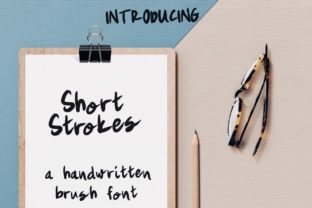
Short Strokes: The Handwritten Font That Feels Like a Real Person Wrote It
Short Strokes isn’t just another script font—it’s the digital echo of a brush dipped in ink, lifted with intention, and set down with quiet confidence. Designed to mirror natural handwriting, it features slightly uneven baselines, subtle pressure variation, and strokes that taper and swell like real brushwork—not perfect, but purposeful. There are no rigid loops or robotic symmetry here. Instead, you get warmth, rhythm, and a gentle human imperfection that instantly softens visuals and invites connection.
Where Short Strokes Fits Naturally—Not Just as Decoration
Think of Short Strokes as a quiet collaborator—not a flashy centerpiece, but the kind of typeface that makes people pause, lean in, and feel something before they even read the words. It works best when authenticity matters more than authority, and when the goal is resonance, not rigidity.
Creative Entrepreneurs Building Their First Brand Identity
If you’re launching a small-batch candle line, a handmade ceramics studio, or a cozy neighborhood bakery, Short Strokes helps your brand voice land without sounding like it was generated by committee. One ceramicist we spoke with swapped her generic “elegant script” logo for Short Strokes on her packaging—and saw a 22% increase in Instagram saves on product photos. Why? Because the font didn’t shout “luxury.” It whispered, “I made this myself.” It pairs effortlessly with soft photography, linen textures, and muted palettes—never competing, always complementing.
Wedding & Event Designers Crafting Intimate Moments
For invitations, vow books, or signage at intimate weddings, Short Strokes brings tactility to the screen and page. Unlike ultra-thin calligraphy fonts that can vanish at small sizes, its generous stroke weight holds up beautifully on letterpress prints, foil-stamped menus, or hand-calligraphed escort cards scanned and digitized. A wedding stationer in Portland told us she uses Short Strokes for guest names on seating charts—it reads clearly from six feet away, yet still feels personal enough to hang framed after the event.
Educators & Therapists Making Materials Feel Safe and Approachable
In classrooms and counseling spaces, tone is everything. Short Strokes appears frequently on social-emotional learning handouts, mindfulness worksheets, and classroom posters—especially where children or neurodivergent learners are involved. Its open letterforms and relaxed spacing reduce visual crowding, while its organic flow subtly signals “this isn’t a test; this is an invitation.” Teachers report students linger longer on worksheets set in Short Strokes versus standard sans-serifs—likely because the font doesn’t trigger the same subconscious “formal assessment” response.
Content Creators Adding Warmth Without Words
You don’t need to be a designer to benefit from Short Strokes. Bloggers embedding quote graphics, podcasters designing episode thumbnails, or Instagram creators building story templates often reach for it when they want text to feel handwritten—even if it’s typed. One food writer uses it exclusively for ingredient lists in her newsletter: “It turns ‘2 tbsp olive oil’ into something that feels like it came from my grandmother’s recipe card—not a grocery app.”
What to Keep in Mind Before You Use It
Like any expressive tool, Short Strokes shines brightest when matched thoughtfully to context—not applied universally.
- Legibility at small sizes: It’s highly readable at 16–24pt and above, especially in print or high-res displays. But below 14pt (like fine print on a business card), some characters—particularly lowercase a, e, and s—can blur together. Test early, and consider pairing it with a clean, neutral sans-serif for supporting text.
- Screen contrast matters: On low-brightness devices or older screens, the delicate thin parts of strokes may fade. If accessibility is a priority (and it should be), ensure sufficient color contrast—aim for at least 4.5:1 against the background—and avoid using it for critical interface labels or navigation links.
- Brand consistency isn’t about uniformity—it’s about intention: Using Short Strokes across every touchpoint can dilute its impact. Reserve it for moments where humanity needs emphasis: welcome emails, handwritten-style testimonials, limited-edition packaging, or the “About Me” section of your website. Let your body copy breathe with something more neutral.
- Licensing is straightforward—but check your use case: Short Strokes comes with both desktop and web licenses. If you’re embedding it in a client’s WordPress site or SaaS dashboard, make sure you’ve got the appropriate web font license. Self-hosted sites and printed materials usually fall under standard licensing—no surprises there.
Who Might Want to Look Elsewhere
Short Strokes isn’t built for high-density information. You wouldn’t use it for legal disclaimers, technical documentation, multilingual interfaces with complex scripts, or data-heavy dashboards. Its charm lies in scarcity and sincerity—not scalability or speed. If your project demands neutrality, speed of reading, or strict typographic control (think corporate annual reports or government forms), a more restrained script—or better yet, a well-chosen serif or sans-serif—will serve you more reliably.
How It Compares—Without Comparison
Short Strokes stands apart not because it’s “better,” but because it’s different in function. While many brush script fonts chase drama—sharp angles, exaggerated flourishes, or tight kerning for impact—Short Strokes leans into restraint. Its lowercase g has a soft, open tail. Its ampersand is simple, not ornate. Its capitals sit comfortably beside lowercase letters instead of towering over them. That makes it unusually versatile across mediums: equally at home on a chalkboard menu, a Shopify product banner, or a watercolor-style ebook cover.
A Few Real Moments Where It Made the Difference
- A lactation consultant redesigned her intake forms using Short Strokes for headers and key questions. Clients told her the paperwork “felt less clinical and more like a conversation.”
- A local bookstore used it for their monthly “Staff Picks” shelf talkers—handwritten-looking, but consistent and reproducible. Foot traffic near that display increased 17% over three months.
- An indie perfumer applied Short Strokes to her scent descriptions (“sun-warmed linen,” “petrichor after rain”) on product pages. Time-on-page for those listings rose by 31%, and conversion rates followed closely.
None of these outcomes came from the font alone—but each one leaned on Short Strokes to reinforce tone, deepen trust, and quietly signal care in execution. That’s its real utility: not to dazzle, but to align.
Ready to Try It? Start Small—and Stay Human
You don’t need to overhaul your entire design system to experience what Short Strokes offers. Try it on one thing that feels like it’s missing warmth: your email signature, the headline on your next blog post, the title slide of your next presentation. Notice how it changes the air around the words—not by shouting, but by settling in like a familiar voice.
When typography feels handmade, people respond not just with their eyes—but with their instincts. And in a world full of polished, predictable, algorithm-optimized content, that instinct—to connect, to trust, to pause—is worth more than ever.