Skull Pathway: A Halloween Font That Delivers Thematic Impact—Without Compromising Legibility
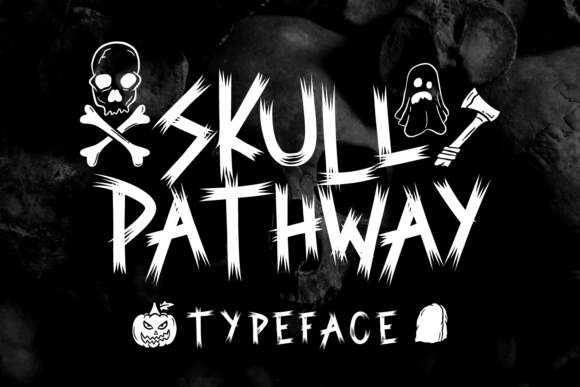
Skull Pathway is a display typeface designed with deliberate, seasonal intent: it evokes the atmosphere of Halloween—not through cartoonish clichés, but through carefully crafted glyphs that suggest decay, mystery, and quiet unease. Unlike many novelty fonts that sacrifice readability for shock value, Skull Pathway maintains typographic discipline while embedding thematic resonance into its letterforms. It’s not merely “spooky”—it’s contextually appropriate, technically sound, and functionally useful for specific creative applications.
What Sets Skull Pathway Apart From Other Halloween Fonts
Most seasonal fonts lean heavily on decorative elements—bats, pumpkins, cobwebs—that either replace or overwhelm core letter shapes. Skull Pathway avoids this trap. Its characters feature subtle yet unmistakable details: hollowed eye sockets in uppercase A and E, cracked serifs reminiscent of fractured bone, and terminals that taper like dried tendons. Lowercase g and q include recessed counters shaped like skull cavities. These aren’t gimmicks layered on top—they’re integrated structural choices.
The font includes standard Latin characters (A–Z, a–z), numerals, punctuation, and basic diacritics. It supports OpenType features like stylistic alternates and ligatures—some of which activate more pronounced skeletal motifs when enabled. This level of typographic control means designers can adjust intensity: use the default set for restrained atmosphere, or toggle alternates for heightened drama.
Practical Use Cases—and Where It Fits Best
Skull Pathway performs strongest where tone and timing align: limited-run seasonal campaigns, event branding, editorial features tied to autumn themes, and experiential design (e.g., escape room signage, haunted attraction posters). A small-batch cider brand used it for their October label redesign—pairing it with warm, desaturated photography and ample whitespace. The result felt cohesive, not costumed.
It also works well in digital contexts with careful implementation. One freelance illustrator applied Skull Pathway to animated Instagram story headers for a horror-themed newsletter. Because the font renders cleanly at 32–48px on modern displays—and avoids thin strokes that blur on low-DPI screens—it remained legible even in motion. That said, it’s not suited for body text, long-form web copy, or accessibility-critical interfaces. Its role is emphatic, not expository.
Quality and Technical Execution
Skull Pathway ships as a professionally hinted OTF/TTF package, with consistent metrics across weights (it offers Regular and Bold). Kerning pairs are thoughtfully adjusted—especially around problematic combinations like AV, To, and Wa—which prevents awkward gaps that often plague themed fonts. Test rendering across platforms (macOS, Windows, iOS) showed no glyph substitution or fallback issues in supported applications (Adobe Creative Cloud, Figma, Affinity Suite).
File size is modest (~120 KB per weight), making it viable for web use via @font-face—though best deployed selectively (e.g., headings only) and with a system-font fallback stack ("Skull Pathway", "Baskerville", "Georgia", serif). Performance impact remains negligible when used judiciously.
Who Benefits Most—and Who Might Want to Pause
Marketing professionals launching time-bound campaigns—especially in food & beverage, entertainment, publishing, or local events—will find Skull Pathway efficient for establishing immediate mood. Educators designing classroom materials for October literacy units report strong student engagement when using it for title pages or chapter headers (paired with accessible body text). Small business owners running pop-up shops or seasonal services appreciate how quickly it communicates theme without requiring custom illustration.
Conversely, professionals working in regulated sectors (healthcare, finance, legal) or brands with strict visual identity guidelines should assess alignment carefully. While Skull Pathway isn’t inherently unprofessional, its aesthetic carries strong associative weight. A tax preparation service using it for a “Spooktacular Savings” promo might unintentionally undermine trust. Similarly, creators targeting global audiences should consider cultural associations: skull iconography carries varied meanings across regions—some neutral or even auspicious—and the font’s tone may not translate uniformly.
Design Integration Tips for Real-World Projects
- Pair intentionally: Contrast Skull Pathway’s texture with clean, neutral sans-serifs (e.g., Inter, Helvetica Neue) or sturdy serifs (e.g., Charter, PT Serif). Avoid other decorative fonts in the same layout—its strength lies in contrast, not competition.
- Respect hierarchy: Use it exclusively for primary headlines or short callouts. Never for navigation labels, form fields, or data tables. One designer noted that applying it to a single line of hero text—then stepping back to a highly legible secondary font for supporting copy—created “instant atmosphere without sacrificing clarity.”
- Test color and background: The font’s depth reads best against muted or dark backgrounds (charcoal, deep burgundy, forest green). On pure white, fine details can appear washed out. Soft shadows or subtle stroke effects (in CSS or design tools) sometimes restore definition—but use sparingly to avoid visual noise.
- Consider licensing scope: Skull Pathway is available under both desktop and web licenses. If deploying on a client site, verify whether the license covers third-party hosting or CMS usage. Some users overlooked this when integrating into WordPress themes and later needed to upgrade.
Limitations Worth Acknowledging
Skull Pathway does not support extended language sets (Cyrillic, Greek, Vietnamese, etc.)—a limitation for multilingual publishers. It also lacks variable font axes, so weight transitions must be managed manually between Regular and Bold. While its alternates add flexibility, they don’t constitute full stylistic families (no Italic, no Condensed). Users needing those variants will need complementary fonts or manual adjustments.
Another practical note: because its character set leans into organic asymmetry, tight tracking or aggressive letter-spacing can disrupt rhythm. One A/B test by a podcast network showed that headlines set at -50–75 units of tracking performed better in click-through rate than those tightened further—suggesting that breathing room preserves its eerie calm rather than amplifying chaos.
Making the Call: Is Skull Pathway Right for Your Next Project?
If your goal is to signal seasonality, evoke mood efficiently, or add memorable texture to a short-form visual message—and you have control over context, audience, and supporting typography—Skull Pathway delivers measurable value. It’s not a universal tool, but it’s a precise one. Its reliability across formats, thoughtful construction, and avoidance of dated tropes make it more durable than most Halloween fonts, which often feel dated within months of release.
For creators weighing alternatives: compare not just aesthetics but integration effort. A hand-drawn font may feel more “authentic” but often requires extensive kerning fixes and inconsistent rendering. A free download might lack OpenType features or proper hinting. Skull Pathway balances craft and utility in a way that saves time downstream—even if the upfront cost is higher than some alternatives.
In practice, it earns its place when used with intention—not as decoration, but as deliberate tonal shorthand. When aligned with audience expectations and project constraints, it doesn’t just scare readers. It makes them pause, recognize context, and engage more deeply with what follows.