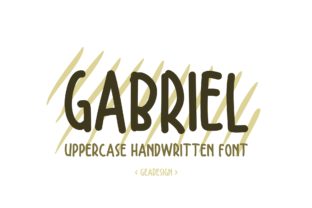
Gabriel: A Sweet, Simple Handwritten Font
There’s something quietly powerful about a font that feels both intentional and effortless—like a thoughtful note passed across a table. Gabriel is exactly that: a sweet and simple handwritten font designed to merge legibility with an easygoing mindset. It doesn’t shout. It invites. And because it balances warmth with clarity, it works where many script fonts fail—on screens, in print, and across real-world creative projects.
What Makes Gabriel Stand Out
Gabriel isn’t just “handwritten.” It’s carefully crafted handwriting—consistent in rhythm, open in spacing, and grounded in readability. Each letter flows naturally without excessive flourishes or unpredictable joins. That means it scales well: from a small caption on Instagram to a large wall quote in a café. Its lowercase ‘a’, ‘g’, and ‘y’ have friendly, familiar shapes—not stylized abstractions—and its uppercase letters maintain gentle contrast without stiffness.
Unlike many script fonts that sacrifice function for flair, Gabriel was built with use in mind. It includes standard OpenType features like ligatures and alternate characters—but only where they enhance flow, not distract. There’s no forced quirkiness. Just honest, approachable typography that supports your message instead of competing with it.
Creative Uses That Actually Work
Think beyond “just for invitations.” Gabriel shines where authenticity and approachability matter most—and where over-designed fonts feel out of place.
- Small business branding: A local bakery, pottery studio, or wellness coach can use Gabriel for shop signage, packaging labels, or email headers—adding personality without sacrificing professionalism.
- Educational materials: Teachers and course creators use it for handouts, worksheet headers, or digital lesson slides. Its clear letterforms help reduce cognitive load, especially for younger learners or neurodiverse audiences.
- Digital content: Bloggers embed Gabriel in Canva graphics or Notion headers. Designers layer it over muted photography for social posts—pairing it with a clean sans-serif (like Inter or Lato) for body text keeps hierarchy intact.
- Printed goods: Wedding stationery, zines, recipe cards, and indie press book covers all benefit from Gabriel’s tactile, human quality—especially when printed on textured paper or with subtle spot varnish.
How Different Creators Adapt Gabriel
One font, many intentions—here’s how real users apply Gabriel with intentionality.
For Marketers & Small Business Owners
You’re not designing a logo—you’re building trust. Use Gabriel sparingly but meaningfully: on a product tagline (“Baked fresh daily”), a value statement (“We listen first”), or a CTA button (“Start your free trial”). Avoid setting full paragraphs in Gabriel. Instead, pair it with a highly legible sans-serif for body copy. This keeps scanning easy while preserving warmth.
For Educators & Content Creators
Clarity comes first. Try Gabriel for section dividers (“Week 3: Building Routines”) or reflective prompts (“What surprised you today?”). In slide decks, use it at 28–36pt for titles—large enough to read from the back of a room, soft enough to feel inclusive. If printing handouts, test contrast: Gabriel works best on off-white or light cream stock, not bright white, which can wash out its subtlety.
For Designers & Freelancers
Don’t default to Gabriel for every handwritten need—ask first: does this project require warmth, or precision? Use it when the goal is connection, not decoration. For example: a nonprofit’s donor thank-you card benefits from Gabriel’s sincerity; a technical SaaS dashboard does not. When customizing, adjust tracking (+20–40) for headlines to prevent crowding, and avoid scaling below 16pt for web use—its delicate strokes lose definition at tiny sizes.
Styling Gabriel Thoughtfully
Good typography isn’t just about picking a font—it’s about shaping how people experience your words. With Gabriel, small decisions make big differences:
- Color matters: Soft charcoal (#333333), deep navy (#2A3B5F), or warm terracotta (#A55A3E) reinforce its grounded tone. Avoid neon or ultra-bright hues—they clash with its calm energy.
- Spacing is non-negotiable: Give Gabriel room to breathe. Add extra line height (1.4–1.6) in multi-line settings. In logos or wordmarks, increase letter-spacing by 50–100 units to preserve openness.
- Pairing keeps it functional: Combine with neutral, humanist sans-serifs (e.g., Poppins, Nunito, or even system fonts like SF Pro or Segoe UI). Avoid other scripts or overly decorative typefaces—they create visual noise, not harmony.
Realistic Ideas You Can Start Today
You don’t need a full rebrand to begin. Here are three low-lift, high-impact ways to bring Gabriel into your work—this week.
- Refresh one recurring template: Swap the header font in your monthly newsletter or client report. Keep everything else identical—just let Gabriel introduce a more personal tone at the top.
- Create a signature visual cue: Use Gabriel for short, repeatable phrases—“Made with care,” “Just for you,” “You’ve got this”—in social bios, email signatures, or website banners. Consistency builds recognition.
- Design a single printed piece: Print a set of 5x7” quote cards using Gabriel + a minimalist layout. Hand them out at your next workshop, leave one in a client’s welcome packet, or mail to a long-time supporter. Tangible = memorable.
Keeping It Clear, Consistent, and Human
The quiet strength of Gabriel lies in its restraint. It doesn’t try to be everything. It asks you to choose where warmth adds value—and where simplicity serves your audience better than spectacle.
That means resisting the urge to overuse it. A headline in Gabriel lands because it’s surrounded by space and contrast—not because it’s everywhere. It means checking readability on multiple devices before publishing. It means trusting that sincerity, when expressed through thoughtful typography, resonates deeper than novelty ever could.
If you’re choosing fonts to reflect who you are—or who you want your brand to feel like—Gabriel offers something rare: confidence without arrogance, friendliness without fuss, and clarity without coldness. It’s not flashy. It’s faithful—to your words, your audience, and the quiet power of well-placed humanity.