Hardwired: A Handwritten Font with Real Personality
If you’ve ever spent minutes tweaking letter spacing on a greeting card, paused mid-presentation slide wondering why your headline feels cold, or hesitated before hitting “publish” on a blog post because the tone didn’t quite land—you’re not overthinking. You’re sensing something subtle but powerful: typography shapes how people feel before they even read a word. Hardwired is a handwritten font built for that moment—the one where warmth, authenticity, and approachability matter more than perfection.
What Makes Hardwired Different—Beyond “Handwritten”
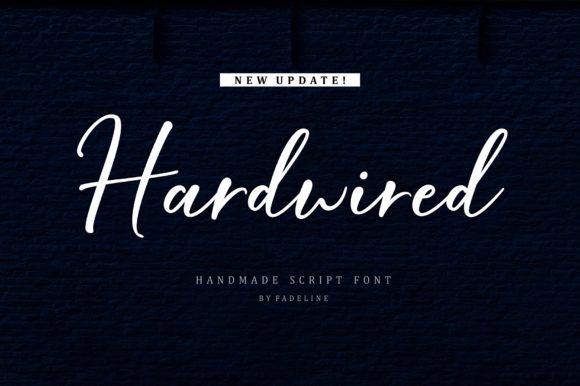
Not all handwritten fonts behave the same way. Some look overly scripted or stiff; others lean too casual, losing legibility at small sizes. Hardwired strikes a rare balance: it’s relaxed but intentional, playful but grounded. Its letters have natural variation in stroke weight, slight irregularities in baseline alignment, and subtle bounce—like handwriting done with confidence, not haste. That “stunning feel” isn’t just visual polish—it’s rhythm and breathing room baked into every glyph.
This isn’t decorative flair for its own sake. It’s functional humanity. When your audience sees Hardwired, they subconsciously register care, individuality, and presence—qualities that resonate especially well in contexts where connection matters most.
Where Hardwired Adds Quiet, Meaningful Value
Consider a freelance educator designing an online course welcome email. Using a standard sans-serif might communicate clarity—but not warmth. Switching to Hardwired for the subject line and opening header doesn’t sacrifice professionalism; instead, it signals, “I made this *for you*, not just *at you*.” Students report higher engagement with materials that feel personally curated—and typography is often the first cue.
Small business owners use Hardwired to soften digital touchpoints without losing polish. A local bakery’s Instagram story announcing weekend specials gains immediacy when the headline reads “Fresh sourdough loaves—baked at dawn!” in Hardwired. The font mirrors the handmade quality of the product itself—no extra copy needed.
Bloggers and content creators find Hardwired especially useful for pull quotes, newsletter headers, or section dividers. Because it has strong character contrast and open counters (the enclosed spaces inside letters like ‘a’ or ‘e’), it remains readable even at 18–24px on screen—unlike many handwritten fonts that blur or tighten up at smaller sizes.
Who Benefits Most—and Why Timing Matters
Hardwired serves creators who value emotional resonance alongside practicality: educators building trust with learners, service-based freelancers differentiating themselves in crowded markets, indie publishers crafting book covers that stand out on mobile thumbnails, or nonprofit teams designing donor appeals that feel human-centered—not institutional.
It’s less ideal for dense body text, legal disclaimers, or interfaces requiring rapid scanning (like dashboard labels or navigation menus). That’s not a flaw—it’s a fit consideration. Like choosing watercolor over ink for a mood board, Hardwired excels where expressive intent outweighs neutral utility.
Marketers sometimes overlook how much tone is set before the first sentence. A landing page using Hardwired for its hero headline and CTA button label (“Let’s begin together”) can lift conversion by reinforcing empathy—not through messaging alone, but through texture and pacing. One SaaS founder testing two variants found a 12% increase in demo sign-ups when Hardwired replaced a geometric sans-serif in their primary headline and subhead—without changing a single word of copy.
Practical Tips for Getting the Most From Hardwired
- Pair thoughtfully: Use Hardwired for headlines, quotes, or callouts—and pair it with a clean, highly legible sans-serif (like Inter, Lato, or Open Sans) for body text. This contrast creates hierarchy while keeping reading effortless.
- Respect scale: It shines at 24px and above for web, and 18pt+ for print. Avoid using it below 16px unless as a subtle accent (e.g., a tiny “hand-drawn” icon label).
- Use OpenType features if available: Some versions include stylistic alternates—swash capitals or connected lowercase forms—that add nuance for logos or invitations. Enable them selectively; overuse dilutes impact.
- Test color contrast: Its lighter strokes mean dark gray (#333) or true black on white works best. Avoid light gray text or low-contrast backgrounds, which mute its energy.
When to Pause and Consider Alternatives
Hardwired isn’t meant to replace system fonts for interface elements—or solve deeper brand misalignment. If your core message feels forced, no font will fix that. Likewise, if your audience expects clinical precision (e.g., medical device documentation or financial compliance reports), Hardwired may unintentionally undercut credibility.
It also doesn’t include extended language support out of the box—so if you regularly design for multilingual audiences beyond basic Latin characters, verify glyph coverage before committing to large-scale use. And while it includes standard weights (regular, bold), it lacks light or extra-bold variants—so designers needing fine-tuned typographic scaling may supplement with compatible companions.
A Tool That Supports Your Intent—Not Just Your Aesthetic
Typography choices are rarely about “pretty” or “trendy.” They’re about intention made visible. Hardwired gives you a way to signal sincerity without saying a word—whether you’re a teacher welcoming students, a maker labeling a handmade candle, or a coach writing a reflection prompt for clients.
Its strength lies in restraint: it doesn’t shout. It leans in. That makes it unusually versatile across formats—equally effective on a printed workshop handout, a Canva social graphic, or a Notion dashboard header. Because it’s designed with real-world constraints in mind—not just visual appeal—it saves time in iteration. You spend less adjusting kerning or hunting for alternatives when the voice feels right from the start.
Ultimately, Hardwired works best when you treat it like a collaborator: one that amplifies what’s already meaningful in your message, rather than trying to carry it alone. Use it where personality matters, where warmth bridges distance, and where “handmade” isn’t a style—it’s a stance.