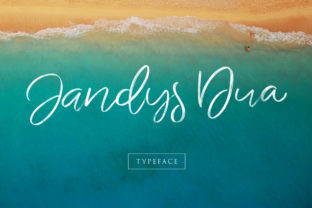
Jandys: A Delicate, Casual Display Font
If you’ve ever scrolled through a mood board and paused at a design that felt effortlessly warm—like handwritten notes on linen stationery or a small-batch coffee label with quiet confidence—you’ve likely sensed the kind of presence Jandys brings. It’s not loud. It doesn’t shout for attention. Instead, Jandys glides in with smooth curves, open spacing, and a gentle rhythm that feels both intentional and unhurried. It’s a display font, designed to carry voice—not volume.
What Makes Jandys Distinctive (Without Trying Too Hard)
Jandys sits comfortably between script and modern sans serif sensibilities. It’s not a true script font—there are no dramatic flourishes or connected letters—but it carries the softness and organic flow of one. Each character has subtle variation in stroke weight, rounded terminals, and a relaxed x-height that keeps it legible without sacrificing charm. Think of it as handwriting refined just enough for clarity, but never polished into sterility.
The personality is unmistakable: casual, sincere, unhurried. It avoids trend-chasing. You won’t mistake it for a tech startup’s bold sans serif or a luxury brand’s high-contrast serif. Jandys belongs to the quiet corner of the design room—the one where authenticity matters more than perfection.
Where Jandys Fits Naturally (and Where It Doesn’t)
Jandys thrives in contexts where warmth and approachability strengthen connection. It’s especially effective in brand identity for small businesses rooted in craft, wellness, food, or slow-living values—think ceramic studios, independent bookshops, botanical skincare lines, or local bakeries. Used thoughtfully in a logo or wordmark, it signals care without pretension.
In editorial design, Jandys shines as a headline or section opener—especially in print magazines, zines, or digital newsletters focused on lifestyle, creativity, or personal growth. Its light contrast and airy spacing support quick scanning while inviting pause. On packaging, it pairs beautifully with natural textures: kraft paper labels, uncoated cardstock, or hand-stamped tags.
For web design, use Jandys sparingly—and always with intention. It works best as a hero headline, testimonial quote, or feature title. Avoid body text: its delicate forms don’t scale well below 24px on screen, and line spacing needs careful adjustment. In social media graphics, it adds instant character to Instagram story overlays or Pinterest quote cards—particularly when layered over soft photography or muted color palettes.
It’s less suited for high-legibility demands: legal disclaimers, dense product specs, or data-heavy dashboards. And while it complements minimalist aesthetics, it can feel out of place next to rigid geometry or aggressive industrial styling.
How Jandys Shapes Perception—Subtly but Surely
Typography isn’t neutral. Even small choices nudge how people feel about your work before they read a single word. Jandys leans into approachability and human scale. That affects brand perception directly: audiences interpret its softness as trustworthiness, not weakness; its simplicity as clarity, not lack of sophistication.
In visual hierarchy, Jandys creates natural emphasis—not by being bigger or bolder, but by offering contrast. Pair it with a clean, neutral sans serif (like Inter, Lato, or even a restrained Helvetica variant) and the interplay becomes instantly readable and emotionally grounded. The contrast doesn’t shout—it breathes.
Consistency matters, too. Because Jandys has a distinct voice, using it across touchpoints—website headers, email subject lines, printed business cards—builds quiet recognition. People may not name the font, but they’ll remember the feeling: calm, considered, human.
Practical Tips Before You Use It
- Check what’s included: Jandys is typically offered as a single-weight display font (often Regular or Medium). It rarely includes italics, bold variants, or extensive language support. Confirm coverage for your project’s needs—especially if targeting multilingual audiences.
- Test readability early: Print a sample at actual size. View it on multiple devices. Does it hold up in small caps? At 36px on mobile? If your use case involves tight layouts or low-resolution screens, adjust spacing or fallbacks accordingly.
- Pair with purpose: Avoid pairing Jandys with other delicate or decorative fonts—that creates visual competition. Instead, choose a sturdy, neutral companion. A slightly condensed sans serif works well for subheads; a warm serif like Merriweather or Libre Baskerville adds gentle contrast for body copy.
- Licensing is non-negotiable: Jandys is a premium font, not free or Google Fonts–hosted. Verify whether your license covers web embedding, desktop use, app integration, or merchandise. Small business owners often overlook this—until they receive a notice. When in doubt, buy directly from the foundry or authorized reseller.
- Consider alternatives—if fit isn’t perfect: If Jandys feels *too* soft for your brand’s energy, explore similar-but-sharper options like Playfair Display (for elegance with structure) or Quicksand (for friendliness with more weight).
A Final Thought: Let It Breathe
Jandys isn’t a font you “plug in” and forget. Its strength lies in restraint. One well-placed headline. A single line of tagline text set with generous letter-spacing and thoughtful margins. A logo lockup where negative space does as much work as the letters themselves.
That’s where its uniqueness becomes functional—not because it’s rare, but because it asks you to slow down, consider tone, and prioritize resonance over reach. For designers building brands with integrity, marketers speaking to real people, or creators sharing work that matters, Jandys isn’t just another creative font. It’s a quiet collaborator—one that reminds us that sometimes, the most confident statement is made softly.