Kampiun Samgor: The Friendly, Hand-Drawn Font That Fits Real Life
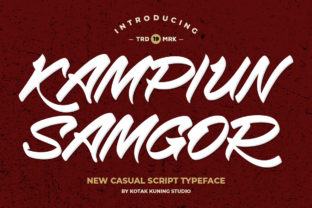
If you’ve ever stared at a design mockup wondering why it feels stiff or overly polished—like it’s trying too hard to be “professional”—you’re not alone. Sometimes what a project truly needs isn’t razor-sharp precision, but warmth, approachability, and a little human imperfection. That’s where Kampiun Samgor steps in: a casual script font built from hand-lettering, with natural flow, subtle variations in stroke weight, and just enough irregularity to feel authentically handmade.
Where Kampiun Samgor Feels Right at Home
This isn’t a font for legal disclaimers or technical manuals—and that’s intentional. Kampiun Samgor shines when the goal is connection, not compliance. Think of it as the visual equivalent of a friendly smile, a handwritten note tucked into a gift bag, or chalk lettering on a café sidewalk.
Small businesses use it to signal personality without shouting. A local pottery studio might pair Kampiun Samgor with a clean sans-serif for body text on their website banner—“Hand-thrown mugs, made with care”—and instantly convey craft, warmth, and authenticity. It doesn’t scream “corporate”; it whispers “I made this myself.”
Event planners lean on Kampiun Samgor for wedding stationery, baby shower invites, or birthday banners—especially when the vibe is relaxed, joyful, or nostalgic. Its gentle curves and open spacing keep things legible even at medium sizes, while still feeling personal. Unlike ultra-decorative scripts that vanish into blur at smaller point sizes, Kampiun Samgor holds its shape well on digital screens and printed paper alike.
Who Benefits—and How
Creative freelancers (illustrators, lettering artists, social media designers) often reach for Kampiun Samgor when clients ask for “something that looks hand-drawn but is actually usable.” It saves hours of custom lettering work while preserving that organic, one-of-a-kind feel. One designer shared how she used it across an entire brand refresh for a children’s book illustrator—on Instagram bios, book cover subtitles, and workshop posters—and got consistent feedback that the typography “felt like part of the art, not just decoration.”
Educators and makers building online courses or printable resources appreciate how Kampiun Samgor softens instructional tone. A downloadable mindfulness journal might use it for section headers like “Breathe In,” “Pause Here,” or “What Feels Light Today?”—making guidance feel gentle, not prescriptive. Teachers printing classroom posters find it especially effective for affirmations, reading corner signs, or student recognition boards.
Food entrepreneurs are quietly adopting Kampiun Samgor for packaging labels, farmers’ market signage, and menu boards. A small-batch jam maker uses it for flavor names (Raspberry & Rose, Lemon-Thyme Honey) alongside a sturdy serif for ingredients—creating contrast that’s both appetizing and trustworthy. It works because it suggests care, not mass production.
Real Moments Where It Makes a Difference
- A nonprofit launching a community storytelling campaign used Kampiun Samgor for quote cards shared across Instagram. Followers commented repeatedly that the font “made the stories feel more real, like someone was speaking directly to me.”
- An indie bookstore chose it for their seasonal newsletter header (“This Month’s Cozy Reads”)—and saw a 22% lift in click-throughs compared to previous months using a standard brush script. Their hunch? It felt less like marketing, more like a recommendation from a friend.
- A therapist redesigned her intake forms to include Kampiun Samgor for section titles (“Things That Feel Heavy Right Now”, “What Gives You Energy?”). Clients said it lowered the emotional barrier to answering honestly.
What to Keep in Mind Before You Use It
Kampiun Samgor is versatile—but not universal. Its strengths are also its boundaries. Because it’s designed to mimic natural handwriting, it prioritizes rhythm and expression over rigid uniformity. That means:
- It’s not ideal for long paragraphs. Use it for headlines, short quotes, labels, or callouts—not body copy. Pair it thoughtfully: a neutral sans-serif (like Inter or Poppins) or a warm serif (like Merriweather or Lora) creates balance without competing.
- Legibility shifts with size and context. At very small sizes (under 14px on screen or under 10pt in print), some letterforms—especially lowercase a, e, and s—can soften into ambiguity. Test it where it’ll live: on mobile, on a tote bag, on a fridge magnet.
- It thrives with breathing room. Tight tracking or cramped line height will squash its charm. Give letters space to breathe—especially in all-caps usage, which Kampiun Samgor supports but handles best with generous letter-spacing.
- Brand voice matters more than trend. If your business is built on authority, speed, or high-tech precision (e.g., cybersecurity, surgical equipment, financial compliance), Kampiun Samgor may unintentionally undercut your message. But if your value is empathy, craft, or human-centered service? It reinforces exactly what you stand for.
Why Designers Come Back to Kampiun Samgor Again and Again
It’s rare to find a script font that feels spontaneous yet remains highly functional. Kampiun Samgor avoids two common pitfalls: the cold stiffness of over-digitized scripts, and the chaotic unpredictability of ultra-loose hand-lettered fonts that break layout consistency. Instead, it offers reliable variation—slight differences in baseline, modest swashes, and organic entry/exit strokes—that add life without sacrificing usability.
And unlike many script fonts limited to uppercase or basic Latin characters, Kampiun Samgor includes thoughtful language support—including extended Latin, diacritics, and punctuation that flows naturally with the hand-lettered aesthetic. That makes it practical for bilingual creators, educators working with diverse classrooms, or global brands wanting localized warmth.
Perhaps most importantly, Kampiun Samgor doesn’t demand attention. It invites it. It doesn’t try to be the hero of every design—it’s happy playing supporting role, lifting up imagery, reinforcing tone, or quietly making a moment feel more human. In a world saturated with algorithm-perfected visuals, that kind of quiet authenticity is becoming harder to find—and more valuable than ever.