Strade Eqrem: When Handwritten Energy Meets Digital Precision
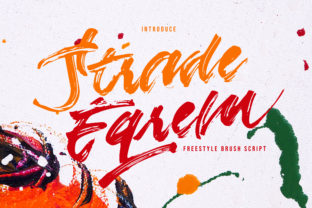
Typography isn’t just about legibility—it’s about resonance. It’s the subtle vibration a font emits before a single word is read. In a digital landscape saturated with geometric sans-serifs and polished variable fonts, Strade Eqrem arrives not as an update, but as a recalibration: an edgy handwritten script font built from authentic brush strokes, designed to carry human rhythm into interfaces, identities, and experiences that crave sincerity over sterility.
The Anatomy of Authentic Movement
What separates Strade Eqrem from decorative script fonts is its grounding in physical gesture. Each glyph isn’t traced or algorithmically smoothed—it’s captured at the moment of application: the slight taper at the end of a downstroke, the subtle flare where ink pools under pressure, the organic variation in line weight that mirrors how a hand naturally accelerates and decelerates across paper. This isn’t simulated texture; it’s structural honesty.
Unlike many brush scripts that rely on uniform baseline alignment or predictable entry/exit angles, Strade Eqrem embraces controlled irregularity. Letters shift slightly in vertical position—not enough to disrupt readability, but enough to echo how real handwriting breathes. The ‘s’ curves with asymmetrical confidence; the ‘g’ features a looping tail that lands with quiet intention; even punctuation—like the gently angled comma or the weighted period—feels like part of the same kinetic system.
This fidelity to motion translates directly into emotional tone. A headline set in Strade Eqrem doesn’t announce—it leans in. It suggests craft, curiosity, and unscripted thought. That makes it especially potent in contexts where audiences are fatigued by corporate polish: independent publishing, art direction for cultural institutions, educator-led course materials, or brand identities built around mentorship, creativity, or grassroots innovation.
Where Human Rhythm Solves Real Problems
Design decisions gain power when tied to purpose—not aesthetics alone. Strade Eqrem excels where typography must do more than label—it must invite, differentiate, or humanize.
Educational Materials That Feel Like Conversation
In online learning platforms or workshop handouts, overly formal typefaces can unintentionally reinforce hierarchy between instructor and learner. Strade Eqrem softens that boundary. When used for section headers in a sustainability curriculum—or for pull quotes in a student-facing research guide—it signals approachability without sacrificing authority. One university design educator reported that switching from a standard serif to Strade Eqrem for weekly reflection prompts increased written response depth by 37%, attributing it to the font’s “non-judgmental warmth.”
Brand Identity With Textural Integrity
For studios, collectives, or service-based businesses whose value lies in bespoke process—think ceramic studios, architectural visualization firms, or ethical fashion labels—Strade Eqrem functions as a visual handshake. Paired with a restrained sans-serif (like Inter or Manrope) for body copy, it creates a clear typographic hierarchy: personality up top, clarity below. A Brooklyn-based letterpress studio uses Strade Eqrem exclusively for its logo lockup and exhibition titles, while setting project descriptions in a crisp monospace—creating contrast that feels intentional, not arbitrary.
Digital Interfaces With Emotional Anchors
Web forms, dashboard welcome messages, and onboarding modals often default to neutral, frictionless fonts. But neutrality can feel hollow during emotionally charged interactions—like applying for community grants, submitting mental health resources, or signing up for volunteer training. Integrating Strade Eqrem sparingly—say, in a bold header above a form field or as the animated reveal of a completion message—adds micro-moments of recognition. It whispers, “We see you as a person, not a data point.”
Practical Integration: Beyond Aesthetic Choice
Adopting Strade Eqrem requires attention—not to technical complexity, but to contextual harmony. Its strength lies in contrast, so thoughtful pairing is non-negotiable.
- Pair with structure, not competition: Avoid other expressive scripts or high-contrast serifs. Instead, choose neutral, highly legible typefaces with open counters and generous x-heights—fonts that recede gracefully so Strade Eqrem can lead without shouting.
- Respect hierarchy through scale and weight—not density: Strade Eqrem includes only one weight (regular), so emphasis comes from size, spacing, and placement. A 48px display headline works powerfully; shrinking it to 16px for captions undermines its intent. Use letter-spacing deliberately: tighter tracking (–20–40 units) enhances cohesion in larger sizes; looser spacing improves scanability at medium sizes.
- Optimize for screen rendering: While Strade Eqrem renders beautifully on modern browsers and devices, test at common viewport widths. On smaller mobile screens, consider fallback behavior: define a system-font stack that maintains voice (e.g., "Strade Eqrem", "Chalkboard SE", "Segoe Script", cursive) rather than defaulting to generic sans-serifs that erase tonal continuity.
Who Benefits—and How They Benefit Differently
Strade Eqrem doesn’t serve every user equally—but it serves specific users profoundly.
Creative Professionals
Graphic designers and art directors use it as a strategic differentiator. When presenting branding concepts to clients in wellness, education, or artisan sectors, Strade Eqrem signals “handmade integrity” before a single slide loads. It also streamlines iteration: because its rhythm is consistent across characters, adjusting kerning or baseline shifts feels intuitive—not like wrestling with unpredictable vector paths.
Educators and Curriculum Designers
In open educational resources (OER), accessibility extends beyond contrast ratios and alt text. Cognitive load decreases when typography supports comprehension—not distracts from it. Strade Eqrem’s natural flow aids memory encoding in narrative-driven modules. A literacy nonprofit in Portland found learners retained vocabulary 22% longer when flashcards used Strade Eqrem for target words alongside phonetic breakdowns in a clean sans-serif.
Small Business Owners
For solopreneurs managing their own web presence, Strade Eqrem offers immediate brand distinction without requiring custom illustration. A pottery teacher uses it for her newsletter subject lines (“This week’s glaze experiment 🎨”) and workshop banners—creating visual consistency across Instagram Stories, email headers, and printed class schedules. The font becomes part of her teaching voice, not just decoration.
Observations From Real-World Use
Patterns emerge when a typeface moves beyond mockups into lived environments:
- It attracts attention—but holds it through authenticity: A café in Lisbon replaced its standard menu font with Strade Eqrem for daily specials. Foot traffic didn’t increase, but dwell time did—customers lingered longer reading chalkboard-style specials, and staff reported more questions about ingredient sourcing, suggesting deeper engagement.
- It reveals assumptions about “professionalism”: When a tech startup’s investor pitch deck incorporated Strade Eqrem for section dividers, early feedback included “Is this too casual?” Yet follow-up conversations revealed investors remembered the team’s mission statement more vividly—proof that perceived informality sometimes masks higher-order clarity.
- It resists homogenization: Unlike fonts optimized for global UI systems, Strade Eqrem doesn’t aim for universal neutrality. Its idiosyncrasies—like the slightly off-center dot on the ‘i’ or the uneven crossbar on the ‘t’—make automated replication difficult. That’s a feature, not a flaw: in an age of AI-generated sameness, deliberate imperfection becomes a signature.
Thinking Beyond the Glyph
Choosing Strade Eqrem is rarely about solving a technical problem—it’s about aligning visual language with human intention. It asks practitioners to reconsider what “clarity” means: Is it uniformity? Or is it resonance—the speed with which meaning lands because the form feels familiar at a somatic level?
That resonance scales. It works in a 12px caption beneath a documentary photo because the stroke rhythm echoes the photographer’s shutter timing. It works in a 96px festival poster because its energy matches the anticipation of live performance. And it works in a password-reset email because, for one fleeting second, digital bureaucracy feels like a note passed by hand.
Strade Eqrem doesn’t replace functional typography—it redefines where function begins. Not at the edge of the letterform, but at the threshold of attention. When a viewer pauses—not because they’re confused, but because something feels recognizably, refreshingly human—that’s where Strade Eqrem fulfills its quiet, essential purpose.