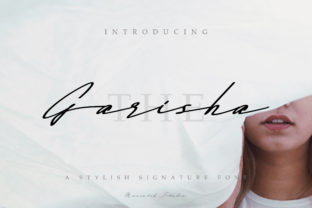
The Garisha: A Signature Script Font for Thoughtful Design Choices
The Garisha is a signature script font—hand-drawn, intentionally irregular, and crafted to evoke the warmth and authenticity of human handwriting. Unlike calligraphic fonts that rely on strict pen angles or monoline scripts built for digital precision, The Garisha balances fluidity with subtle variation in stroke weight, spacing, and rhythm. It’s not merely decorative; it’s expressive, with each character shaped to support legibility at moderate sizes while retaining personality at larger scales.
What Sets The Garisha Apart from Other Script Fonts
Many script fonts fall into one of two categories: highly formal (think copperplate-inspired typefaces with sharp contrast and tight letterfit) or casual brush scripts with exaggerated bounce and looseness. The Garisha occupies a considered middle ground. Its baseline gently undulates—not rigidly level, but not wildly uneven either. Letter connections are present but not obligatory; optional ligatures offer refinement without forcing continuity. This makes The Garisha adaptable across contexts where tone matters: a boutique brand identity may lean into its elegance, while an artisanal food label might highlight its approachable texture.
Unlike vector-based scripts designed for maximum scalability, The Garisha includes intentional imperfections—slight tapering at terminals, minor ink bleed effects, and variable x-heights across glyphs. These aren’t flaws; they’re design decisions meant to signal craftsmanship over automation. That distinction becomes meaningful when evaluating how a font will age visually or resonate with audiences who increasingly value authenticity in visual language.
Where The Garisha Fits in Real-World Projects
The Garisha excels in applications where voice and intentionality matter more than sheer versatility. Wedding invitations, small-batch product packaging, editorial mastheads, and boutique website headers are natural fits. Its rhythm supports short-form text beautifully: a tagline, a chapter title, or a logo lockup. In those cases, The Garisha doesn’t compete with body text—it complements it, offering contrast without clashing.
It’s less suited for long paragraphs, interface labels, or environments requiring high functional legibility (e.g., mobile app navigation, data dashboards, or accessibility-critical signage). That’s not a shortcoming—it’s a boundary rooted in typographic function. Just as you wouldn’t choose a serif for ultra-small UI text, The Garisha isn’t engineered for dense reading. Recognizing that boundary helps avoid misapplication and preserves its impact where it counts.
Comparing Approaches: Script vs. Display vs. Hand-Lettered Alternatives
When designers explore script options, they’re often weighing three broader approaches: traditional script fonts (often based on historical writing systems), modern display scripts (optimized for headlines and branding), and hand-lettered assets (custom-drawn illustrations, not fonts at all). The Garisha belongs firmly in the second group—but with traits borrowed from the third.
Compared to traditional scripts, The Garisha avoids rigid rules around entry/exit strokes or strict slant consistency. That gives it flexibility across languages and layouts where strict calligraphic logic would feel forced. Compared to many modern display scripts, it resists over-stylization: no excessive swirls, no artificial bounce, no forced asymmetry. Its restraint makes it easier to pair with clean sans-serifs or even modest serifs without visual competition.
Hand-lettered solutions offer total uniqueness but lack scalability and typographic control—each word must be redrawn, adjusted, and kerned manually. The Garisha delivers much of that bespoke feel *as a font*, with OpenType features like contextual alternates and swash variants. That balance—between custom expression and practical utility—is where its value crystallizes for time-constrained professionals.
Practical Considerations and Tradeoffs
Like any specialized tool, The Garisha comes with tradeoffs worth acknowledging before licensing or implementation:
- Licensing scope: Most versions include desktop and web use, but app embedding or large-scale merchandise reproduction may require extended licenses. Always verify usage rights against your intended deployment.
- Language support: The core set covers Latin-based languages thoroughly—including accented characters common in French, Spanish, and German—but doesn’t extend to Cyrillic, Greek, or Asian scripts. If multilingual support beyond Western European languages is essential, supplementing with a secondary font may be necessary.
- Pairing discipline: Because of its expressive nature, The Garisha benefits from thoughtful pairing. A neutral, well-spaced sans-serif (like Inter, Poppins, or Adobe Clean) tends to provide the clearest contrast. Avoid pairing it with other decorative or high-contrast fonts unless the hierarchy is deliberately hierarchical and the context highly controlled.
- Rendering variability: On lower-resolution screens or older browsers, subtle stroke variations may soften. Test across devices—especially if using The Garisha in responsive web headers or email templates.
When The Garisha Is the Right Choice—and When It Isn’t
The Garisha is strongest when your goal is to communicate care, craft, or individuality—not neutrality or universality. If your project centers on personal connection (a therapist’s website, a handmade ceramics studio, a literary journal), its human rhythm reinforces that message. It also works well where differentiation matters: in saturated markets where polished, algorithmically generated aesthetics dominate, The Garisha offers quiet distinction.
Conversely, if your priority is speed, scalability across dozens of languages, strict accessibility compliance (e.g., WCAG AA+ for body copy), or integration into a system with heavy automation (like dynamic CMS-generated banners), The Garisha likely isn’t the primary tool you need. That doesn’t diminish its quality—it simply reflects functional specialization. Choosing wisely means matching the tool to the task, not assuming one font must serve every role.
Realistic Examples Across Mediums
A regional bakery uses The Garisha for its logo and seasonal menu headers, paired with a warm, slightly rounded sans-serif for ingredient lists and hours. The contrast signals “made by hand” without sacrificing readability where customers need information quickly.
A freelance illustrator licenses The Garisha for client-facing proposals and presentation decks—not for the entire slide deck, but for section titles and signature lines. It adds polish without demanding redesign of every layout element.
An indie publisher selects The Garisha for chapter titles in a memoir, setting them against generous margins and generous leading. Here, its slight irregularity echoes the narrative’s reflective, personal tone—something a perfectly uniform script couldn’t convey.
Making Your Decision with Confidence
Choosing a script font isn’t just about aesthetics—it’s about aligning visual tone with communication goals, audience expectations, and technical constraints. The Garisha stands out not because it’s the most versatile or the most widely supported, but because it fulfills a specific, increasingly relevant need: expressing humanity within digital tools.
If you value intentionality over convenience, subtlety over spectacle, and craft over convention, The Garisha deserves serious consideration. But take time to test it in your actual workflow: paste real copy, simulate real sizes, check contrast ratios, and assess how it behaves alongside your existing type system. That kind of grounded evaluation—neither rushed nor overly theoretical—is what leads to durable, effective typography choices.
Ultimately, The Garisha isn’t a replacement for other scripts or display fonts. It’s another articulate voice in a diverse typographic repertoire—one worth hearing when the message calls for something quietly distinctive.