Elementary Elle: The Nostalgic Script Font That Bridges Learning and Design
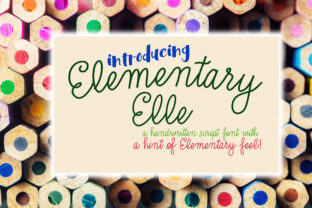
There’s something quietly powerful about handwriting that feels like it belongs on a lined notebook page—slightly uneven, warmly human, full of quiet intention. Elementary Elle captures that feeling precisely. It’s not a sterile digital script or an overly ornate calligraphy font. Instead, it’s a classic script typeface designed with the gentle rhythm and subtle imperfections of elementary school penmanship—rounded letterforms, soft joins, and consistent baseline flow that evoke chalkboards, hand-drawn posters, and first attempts at cursive.
This isn’t nostalgia for nostalgia’s sake. In a digital landscape saturated with ultra-polished, algorithm-optimized visuals, authentic texture matters more than ever. Elementary Elle answers a real need—not just for educators making classroom materials, but for creators across industries who want warmth without whimsy, clarity without coldness, and personality without pretense.
Why a “Schoolroom” Font Fits Modern Creative Workflows
Today’s professionals—from freelance designers building brand identities to small business owners crafting email newsletters—routinely juggle speed, consistency, and emotional resonance. Tools like Canva, Figma, and Google Slides have democratized design, but they’ve also created pressure to stand out in ways that feel genuine, not generic. Stock fonts often fall short: sans-serifs can read as corporate or detached; decorative scripts risk looking dated or hard to read at scale.
Enter Elementary Elle. Its balanced x-height and open counters ensure legibility even at smaller sizes—crucial for slide decks, printable worksheets, or social media graphics. At the same time, its natural stroke variation and rhythmic spacing lend visual interest without demanding attention. You don’t need to be a typographer to use it well: apply it to a workshop title, a course module header, or a handmade-style product label, and it immediately signals approachability and care.
Consider a homeschooling parent designing weekly learning plans. Or a wellness coach launching a mindfulness journal with handwritten prompts. Or a boutique stationery brand introducing a new line of educational flashcards. In each case, Elementary Elle functions not as decoration—but as a quiet bridge between function and feeling.
From Classroom Walls to Brand Strategy: How Script Fonts Evolved
Script fonts have long carried cultural weight. Mid-century advertising used them for charm and trust. In the 1990s and early 2000s, they leaned into playfulness—think birthday party invites and café chalkboard menus. But over the past decade, their role has matured. Designers now treat script faces less as “fun extras” and more as intentional voice carriers—especially in education, mental health, early childhood development, and values-driven branding.
What changed? A broader shift toward human-centered communication. As AI-generated content grows more prevalent, audiences subconsciously seek signals of human presence: slight asymmetry, thoughtful spacing, tactile nuance. Elementary Elle doesn’t mimic handwriting—it interprets it. Its lowercase ‘a’ and ‘g’ follow traditional schoolbook forms, and its capital letters retain enough structure to remain professional, not childish. That balance is rare—and increasingly valuable.
Practical Use Cases Across Roles and Industries
Elementary Elle works where clarity meets connection. Here’s how different users apply it meaningfully:
- Educators and curriculum designers use it for lesson headers, reading logs, and student-facing rubrics—reinforcing a supportive, low-pressure learning environment without sacrificing readability.
- Freelance designers pair it with clean sans-serifs (like Inter or Open Sans) to create contrast-rich layouts for e-learning platforms, workshop handouts, or nonprofit campaign assets—adding warmth while keeping information architecture intact.
- Small business owners integrate it into packaging for children’s books, STEM kits, or Montessori-inspired toys—communicating pedagogical intentionality at a glance.
- Bloggers and content creators apply it selectively: as pull-quote styling in long-form posts about learning science, or as a recurring motif in newsletter banners that emphasize reflection, growth, or foundational skills.
- Nonprofits and advocacy groups use it in reports and infographics focused on literacy, early education access, or teacher support—softening data-heavy content while honoring the humanity behind the numbers.
The key is restraint. Elementary Elle shines most when it anchors meaning—not when it competes for attention. One headline per page. A single callout per section. A consistent size and weight across a project. Overuse dilutes its impact; thoughtful placement amplifies it.
Designing with Intention: Pairing and Technical Notes
Elementary Elle was built with modern file formats and cross-platform compatibility in mind. It includes standard OpenType features—ligatures, stylistic alternates, and multilingual support—so it performs reliably whether embedded in a PDF, rendered in a web browser, or exported from Adobe Illustrator.
For pairing, lean into contrast. Its friendly curves pair naturally with structured, neutral sans-serifs. Try it with Manrope for digital dashboards, Lora for printed workbooks, or IBM Plex Sans for institutional communications. Avoid other script fonts or overly decorative serifs—they’ll clash tonally and visually.
When using Elementary Elle digitally, keep accessibility in view. It’s best suited for headings, short labels, and accent text—not body copy. For screen readers and SEO, always wrap headings in proper semantic HTML (h2, h3) and provide descriptive alt text for any image-based usage.
More Than a Font—A Design Mindset
Choosing Elementary Elle reflects a broader design philosophy: one that values clarity rooted in empathy, professionalism shaped by personality, and efficiency informed by experience. It acknowledges that learning doesn’t stop at age 12—and neither does our need for tools that honor curiosity, patience, and incremental growth.
In classrooms, it reminds students that effort matters more than perfection. In marketing, it tells customers that expertise doesn’t require distance. In personal projects, it offers a gentle nudge back to fundamentals—the kind of focus, repetition, and joyful practice that builds real skill.
That’s why Elementary Elle resonates beyond its literal use case. It’s not about recreating elementary school—it’s about reclaiming the mindset those years cultivated: openness to trying, safety in making mistakes, and respect for the process behind every mastered concept.
Getting Started Thoughtfully
If you’re exploring Elementary Elle for a current project, begin small. Test it in one high-impact spot: a course title, a workshop banner, or the opening line of a resource guide. Compare how it reads next to your current font—does it clarify tone? Does it invite closer reading? Does it feel aligned with your audience’s expectations—not just your aesthetic preferences?
Remember: typography is never neutral. Every font carries associations, rhythms, and implied values. Elementary Elle brings forward ideas of foundation, care, and continuity. Used with awareness, it becomes part of your message—not just its wrapper.
Whether you're launching a new online course, redesigning a school newsletter, or developing inclusive learning tools for neurodiverse learners, this font offers more than visual charm. It offers coherence. It offers calm. And in a world moving faster by the day, those qualities aren’t nostalgic—they’re necessary.