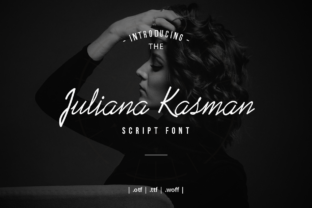
Juliana Kasman: A Stylish Script Font
Juliana Kasman is a script font designed to feel personal, expressive, and effortlessly elegant. It’s not the kind of typeface you’d use for long paragraphs or data tables — instead, it shines where personality matters most: logos, invitations, social media graphics, packaging, and short headlines. What sets Juliana Kasman apart is its gentle variation in baseline — letters don’t sit rigidly on one line but rise and fall like natural handwriting. Paired with smooth, flowing strokes and subtle irregularities, it carries a warm, handmade touch that feels human, not digital.
Why Designers and Creators Choose Juliana Kasman
People turn to Juliana Kasman when they want their work to feel intentional, refined, and emotionally resonant — without looking overly formal or stiff. Its rhythm invites attention, but never overwhelms. Unlike many script fonts that lean heavily into calligraphy or dramatic flourishes, Juliana Kasman balances elegance with approachability. That makes it especially useful for creators who need visual distinction but also clarity and warmth.
For small business owners launching a new brand, Juliana Kasman can help convey care and authenticity — think of a local bakery’s chalkboard sign, a boutique skincare label, or a wedding planner’s business card. Freelancers building portfolios often use it to highlight their name or tagline, adding quiet confidence without shouting. Educators designing classroom posters or digital handouts sometimes choose Juliana Kasman for titles to soften academic tone while keeping things polished.
Where Juliana Kasman Fits Naturally
This font works best in contexts where brevity meets intention. Here are some everyday examples:
- A blogger using Juliana Kasman for Instagram story headers — pairing it with a clean sans-serif body font creates visual hierarchy and charm.
- A wedding stationery designer setting “Mr. & Mrs.” in Juliana Kasman over a minimalist background, letting the baseline variation echo the organic flow of handwritten vows.
- A craft entrepreneur stamping product tags with a custom logo built around Juliana Kasman — the slight imperfections make mass-produced items feel more personal.
- An online course creator using it for section titles in a PDF workbook — just enough flair to guide the eye, not so much that it distracts from learning.
It’s also well-suited for print applications like greeting cards, book covers, and event signage — especially when paired with thoughtful spacing and restrained color palettes. Because Juliana Kasman has generous letter spacing and open counters (the enclosed spaces inside letters like ‘a’ or ‘e’), it remains legible even at modest sizes — though it’s still best reserved for larger display text rather than body copy.
What Makes Juliana Kasman Stand Out
The varying baseline is more than a stylistic quirk — it adds movement and breath to static text. Letters don’t march in lockstep; they sway slightly, like someone writing with relaxed confidence. The lines are smooth but never mechanical — there’s a softness to curves and terminals that avoids cold precision. And because it includes alternate characters and ligatures in its full version, users can fine-tune how connected or airy the text feels.
This isn’t a font that tries to do everything. Its strength lies in focus: it supports voice, mood, and identity in moments that matter most. That restraint is part of what makes Juliana Kasman feel trustworthy and mature — not trendy, but time-aware.
Things to Keep in Mind Before Using Juliana Kasman
Like any expressive script font, Juliana Kasman works best when used thoughtfully. First, consider context: if your project needs high readability at small sizes or fast scanning (like app interfaces or legal disclaimers), this isn’t the right choice. Second, pairing matters. Juliana Kasman pairs beautifully with neutral sans-serifs — think Inter, Lato, or Montserrat — but clashes with other decorative or heavy scripts.
Also, check licensing. While many designers use Juliana Kasman for personal projects under standard licenses, commercial use — especially in client work or products for resale — may require an extended license. Always verify permissions before embedding it in websites, apps, or physical goods.
And remember: consistency helps. If you use Juliana Kasman for your logo, consider applying it sparingly elsewhere — perhaps only for headings or accent text — to preserve its impact. Overuse can dull its distinctiveness and reduce its emotional resonance.
Getting Started Is Simple
You don’t need advanced typography knowledge to begin working with Juliana Kasman. Start by downloading a trial or licensed version from a reputable foundry or marketplace. Open it in your design tool — whether that’s Canva, Adobe Illustrator, Figma, or even Google Docs (with proper upload and activation) — and experiment with short phrases: a name, a motto, a seasonal greeting.
Try adjusting tracking (letter spacing) slightly tighter for intimacy, or looser for airiness. Test how it looks against light and dark backgrounds. See how it flows next to your go-to body font. Even small tweaks reveal how responsive and expressive Juliana Kasman can be.
Beginners often find success by using it as a “signature element” — not the whole design, but the part that says, “This is mine.” That could be a monogram on a tote bag, a title slide in a presentation, or the “Thank You” frame at the end of a video. In those moments, Juliana Kasman doesn’t just look good — it feels meaningful.
Final Thought: Style With Substance
Fonts like Juliana Kasman remind us that typography is never neutral. Every curve, every slant, every shift in baseline communicates something — even if silently. Juliana Kasman communicates warmth, intention, and quiet confidence. It doesn’t shout trends; it supports values. Whether you’re launching a side hustle, designing for a loved one’s milestone, or refining your personal brand, choosing Juliana Kasman is a small decision with a noticeable effect — one that says you care about how things feel, not just how they look.