Phillips Muler: A Thoughtful Evaluation for Designers
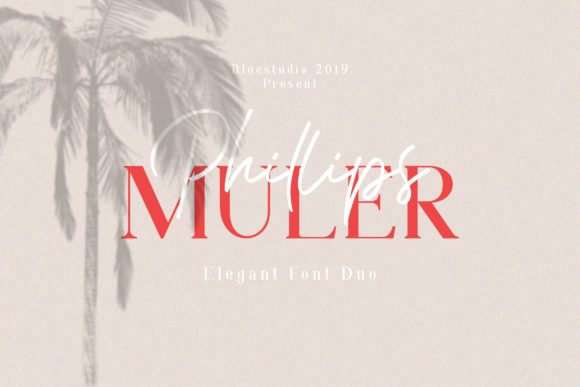
Phillips Muler is a carefully crafted font duo consisting of a serif and a sans-serif typeface designed to work harmoniously together. Released as a matched pair, it emphasizes visual cohesion—particularly in projects requiring both typographic contrast and consistency across headings, body text, captions, and interface elements. Its design language balances traditional serif structure with modern sans-serif clarity, resulting in a refined appearance suited to editorial layouts, branding systems, and digital interfaces where tone and readability matter.
Why Designers Consider Phillips Muler
Designers often seek typefaces that support both aesthetic intent and functional performance. Phillips Muler appeals to those prioritizing typographic versatility without sacrificing elegance. Its pairing logic means less time spent testing compatibility between fonts and more time refining hierarchy and rhythm. Users frequently cite its balanced x-height, open counters, and restrained stroke contrast as strengths—features that contribute to legibility at small sizes and presence at large ones.
It’s also common for designers evaluating Phillips Muler to be working on identity systems, publishing platforms, or long-form web content where consistent voice and visual refinement are central. The font’s neutral-yet-characterful tone avoids trend-driven extremes, making it suitable for contexts where longevity and adaptability are valued over novelty.
Practical Benefits and Real-World Tradeoffs
One clear benefit of Phillips Muler is its intentional pairing. Unlike standalone fonts that require manual tuning to achieve harmony, the serif and sans-serif variants share metrics—including similar cap height, ascender/descender proportions, and spacing behavior. This alignment reduces layout inconsistencies, especially in responsive environments where line breaks and column widths shift dynamically.
Another advantage lies in its licensing model: Phillips Muler is available under an open-source license (SIL Open Font License), allowing free use in commercial and personal projects without attribution requirements. This makes it accessible for startups, independent developers, and educators who need reliable typography without budget constraints.
However, tradeoffs exist. While Phillips Muler performs well in print and high-resolution displays, its relatively low contrast and modest stroke variation may limit impact in large-scale environmental applications—such as signage or billboards—where stronger visual weight or higher contrast is needed for quick recognition. Similarly, its restrained personality may feel too subdued for brands seeking bold expressiveness or cultural distinctiveness.
Language support is another consideration. Phillips Muler covers Latin-based scripts comprehensively, including extended diacritics for Western, Central, and Eastern European languages. It does not include Cyrillic, Greek, or CJK characters. Projects targeting multilingual audiences beyond Latin-script regions will need supplemental typefaces—or should verify whether third-party extensions or community forks address those gaps.
Situations Where Phillips Muler Is a Strong Fit
Phillips Muler excels in scenarios where typographic unity and quiet sophistication are priorities. Examples include:
- Editorial websites and digital magazines — Its serif variant supports readable body copy, while the sans-serif provides clean, unobtrusive headings and UI labels.
- Brand identity systems for professional services — Law firms, academic institutions, or design studios often benefit from its understated authority and lack of stylistic distraction.
- Documentation and technical writing platforms — Consistent metrics and generous letter spacing improve scanning efficiency and reduce cognitive load across dense information sets.
- Printed reports and annual reviews — Its even color and moderate contrast translate reliably across offset and digital printing processes.
When Alternatives May Be More Appropriate
Phillips Muler is not universally optimal. Designers should consider alternatives when:
- High legibility at very small sizes is critical — Fonts like Inter or Roboto offer tighter hinting and optimized screen rendering for UI text under 14px.
- Expressive differentiation between heading and body is desired — A more contrasting pair—such as Playfair Display with Lato—may better serve campaigns or editorial features needing dramatic typographic contrast.
- Multilingual support beyond Latin scripts is required — Type families like Noto Serif/Noto Sans or IBM Plex provide broader script coverage out of the box.
- Customization or variable font capabilities are needed — Phillips Muler is currently available only in static weights; projects requiring optical sizing, grade adjustments, or continuous weight interpolation may benefit from variable alternatives like Recursive or Source Serif/Source Sans.
Making an Informed Decision
Evaluating Phillips Muler effectively involves aligning its characteristics with concrete project goals—not just visual preference. Begin by auditing your typographic needs: What roles will type play? How many weights and styles are necessary? Which scripts must be supported? What environments will the type appear in—print, desktop, mobile, or embedded systems?
Test Phillips Muler in context early. Render real content—not placeholder text—at actual sizes and weights. Observe how it behaves with your color palette, line lengths, and surrounding visual elements. Pay attention to how it scales across breakpoints and whether its rhythm supports your content’s intended pace and emphasis.
Compare it directly against shortlisted alternatives using identical test conditions. Note differences not only in appearance but in file size, loading performance (for web use), and developer tooling support—such as CSS variable readiness or build-system compatibility.
Finally, consider maintenance. As an open-source typeface, Phillips Muler benefits from community contributions, but updates may be infrequent compared to commercially backed families. Review its GitHub repository or official site for recent activity, issue resolution patterns, and documentation quality—indicators of long-term viability.
Conclusion
Phillips Muler offers a pragmatic solution for designers seeking a cohesive, elegant, and freely usable font duo. Its strength lies in thoughtful integration rather than stylistic dominance—making it especially valuable in projects where typography serves communication first and decoration second. It is neither a universal replacement nor a niche curiosity, but a considered option among many. Whether Phillips Muler fits your work depends less on its inherent qualities and more on how precisely those qualities match your functional requirements, audience expectations, and implementation constraints. Evaluating it alongside realistic use cases—and comparing it transparently against alternatives—provides the clearest path to a confident, sustainable typographic choice.